This Solo Founder Turned Down $11 Billion

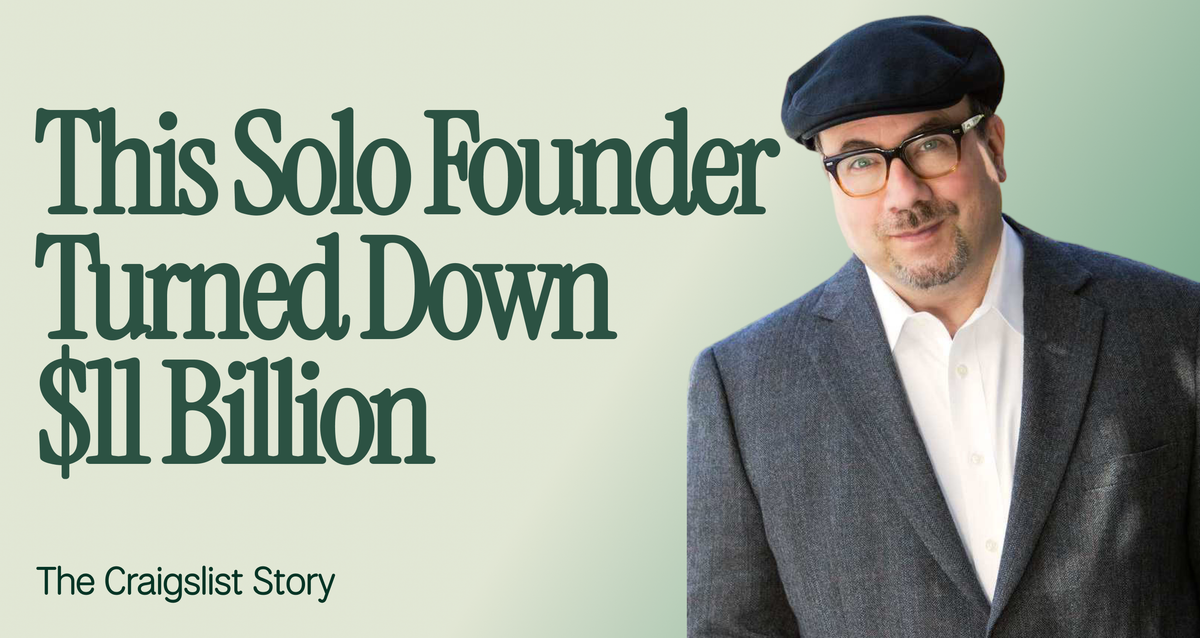
Craig Newmark started Craigslist solo, demoted himself to customer service, and walked away from an estimated $11 billion. Thirty years later, he's giving the rest away.
"I turned down around $11B that bankers and VCs wanted to throw at me."
In December 2025, Craig Newmark estimated that his decision to keep Craigslist mostly free had cost him $11 billion in potential wealth. It was the choice that defined Craigslist: refusing to monetize the site the way bankers and venture capitalists wanted him to.
Newmark isn’t bothered by it. The self-described Forrest Gump of the internet doesn’t own a car or have a personal assistant, and says he has “the attitudes and tastes of a peasant.” For eighteen years, the founder of one of America’s most-visited websites personally answered its customer service emails. Today, he spends a meaningful chunk of his time funding pigeon rescue.
That’s not the life of a typical founder, and Newmark never set out to be a founder in the first place. “Frankly, I never thought about entrepreneurship at all until I found myself by accident being one,” he has said. What makes his story unusual is everything he did on purpose afterward. He kept Craigslist mostly free, handed off the CEO job, and is now giving away much of the wealth he did accumulate. And because Craigslist never took outside funding, those choices were his to make.
The accidental founder
Before Craigslist, Newmark lived a fairly ordinary engineer’s life. After 17 years writing code at IBM, he moved to San Francisco in 1993 for a job at Charles Schwab. A coworker there introduced him to the World Wide Web, back when it was still mostly free of ads and commerce.
In early 1995, at 42, he started emailing a few dozen friends a list of local arts and tech events. People kept asking to be added. Then they started asking for things that had nothing to do with events: an apartment, a job, someone to take a couch off their hands. If it could be listed, it ended up on the list.
By that summer, about 240 addresses were crammed into the CC line, and his email tool broke under the weight. Moving to a proper listserv meant giving the thing a name. Newmark wanted to call it “San Francisco Events.” His friends, though, were already calling it Craig’s List. “I had inadvertently created a brand,” he said. “[A friend] explained to me what a brand is, because I didn’t know. I was that far removed from a business.”
Newmark wasn't following a business plan. He was building around what people kept asking for. Jimmy Douglas, the solo founder of electric vehicle marketplace Plug, experienced something similar when car owners started asking his company for cash offers, even though nothing on its website mentioned them. On the Solo Founders Podcast, Douglas described this kind of unexpected customer demand as:
“what market pull actually feels like.”
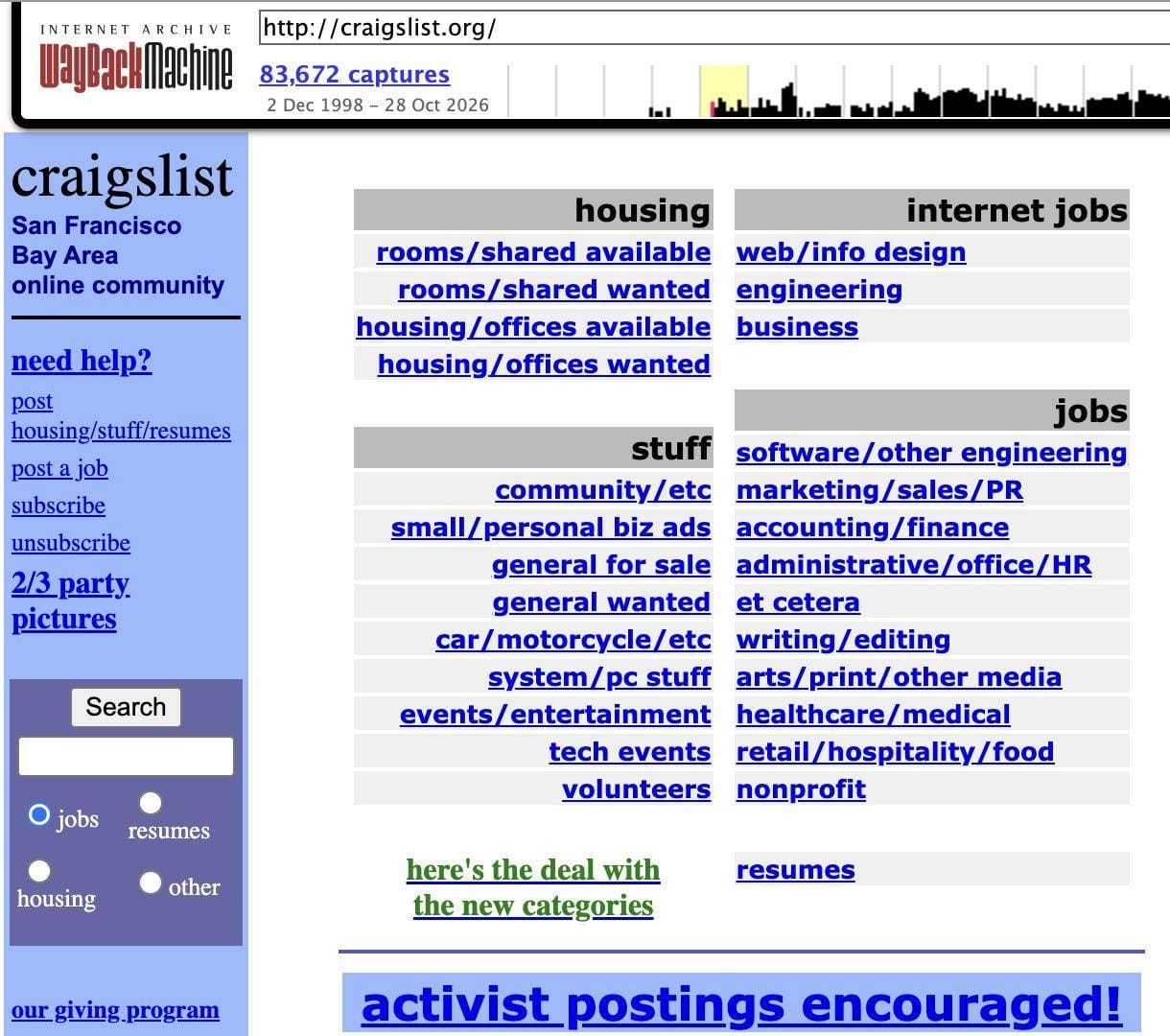
What people were posting was exactly what newspapers charged for. Before Craigslist, selling a couch or hiring someone usually meant buying space in a newspaper’s classifieds. The ads ran as a few lines of tiny type, priced by the line, reaching only that paper’s own readers. Craigslist did the same thing at almost no cost, instantly, without a word limit, for anyone online. It became a website in 1996, a company in 1999, and by the end of 2003 it had launched local sites in 29 U.S. cities.
The newspapers felt it. A study in Management Science estimated Craigslist drained $5 billion from American newspapers between 2000 and 2007 alone. Back then, classifieds made up roughly 40% of the average paper’s revenue. Newmark has never fully settled how much of that was his doing. “I’ve always wondered about that,” he said. “I think it had an effect.”
Enough is enough.
As Craigslist grew, bankers and venture capitalists came to Newmark’s door, all with the same pitch. Run banner ads. Charge for listings. Sell subscriptions. Monetize it like the rest of the internet.
Newmark had other ideas. When Craigslist became a company in 1999, he made a deliberate choice to monetize it as little as possible. Almost everything stayed free. The company charged only for a narrow set of things, like job posts in a handful of cities and brokered apartments in New York.
It's the choice that helps explain the $11 billion Newmark estimates he left on the table. But he doesn't regret it. “That doesn’t bother me,” he said, “because my moral compass was set in Sunday school…You should know when enough is enough.”
The founder who fired himself.
In late 1999, a 6-foot-7 medical school dropout named Jim Buckmaster posted his résumé online, hoping to find web programming work. Fittingly, Newmark found him through Craigslist and hired him as lead programmer in January 2000.
Around the same time, Newmark reached a conclusion most founders never reach about themselves. “I was bad about making tough decisions, like hiring and firing,” he said. “I really sucked at that.” The people around him agreed and nudged him to find someone better. In November 2000, he made Buckmaster, hired less than a year earlier, CEO.
Then Newmark took the job he actually wanted: frontline customer service rep. He answered emails, booted spammers and scammers, and reported to a senior rep, all while still chairing the board. He was, as he put it, “simultaneously on the top and bottom of the company.”
One journalist described him as having “obsessive customer service disorder.” Newmark has long argued that good customer service is a profit center, even if the returns are hard to measure. Decades later, he summed up his career in one LinkedIn post: “30 yrs of craigslist: I suck at management, but I’m great in customer service.”
Founding alone doesn't mean doing everything alone. It means knowing where you're strong, where you're not, and when to bring in someone better. Sunil Rajaraman, the solo founder of Hamlet, made a similar point on the Solo Founders Podcast when discussing what it takes to go solo:
“you know what your weaknesses are, and you know what you don’t enjoy.”
Newmark understood both. Rather than forcing himself to be the CEO, he found someone better suited to the role and focused on the work he enjoyed.
Craigslist vs. eBay
The same year Newmark started his email list, another Bay Area solo founder, Pierre Omidyar, launched the auction site that became eBay. Both built marketplaces for ordinary people selling ordinary things. But their companies came to represent very different philosophies about making money on the internet. And in 2004, eBay ended up owning nearly a third of Craigslist.
For years, Craigslist had just three shareholders: Newmark, Buckmaster, and a former employee named Philip Knowlton. Knowlton wanted Craigslist to make far more money. Newmark and Buckmaster kept refusing. So in 2004, Knowlton sold his 28.4% stake to eBay. The deal cost eBay $32 million: $16 million to Knowlton, and $8 million each to Newmark and Buckmaster for additional rights. It also gave eBay a seat on Craigslist's board.
The culture clash was immediate. Newmark remembered a board dinner at a restaurant far too fancy for his taste. "Pierre showed up with guys with things in their ears and I thought, 'This isn't my lifestyle.'" Internal eBay emails later showed executives mocking Newmark and Buckmaster’s “amateurish board meetings” and their inability to run PowerPoint.
In 2007, eBay launched Kijiji in the U.S., a direct Craigslist competitor. Craigslist accused eBay of using confidential information from its board seat to help build Kijiji. Newmark and Buckmaster asked eBay to sell its stake back, but eBay refused. So they issued themselves new shares, reducing eBay’s ownership from 28.4% to 24.9% and stripping it of its board seat. eBay sued, and the case went to trial in Delaware in 2009.
Under cross-examination, Newmark was asked whether he’d ever even looked at Kijiji, the site at the center of the case. “I've never looked at it,” he said. He compared learning about its launch to being cheated on by a spouse. Asked to describe his job, he told the court he was a customer service rep.
Chancellor William Chandler’s September 2010 ruling went mostly eBay’s way. He sided with eBay on two of its three claims, including the dilution, which he ordered undone. Even so, his opinion drew a sharp line between the two companies. “It might be said that ‘eBay’ is a moniker for monetization,” he wrote, “and that ‘craigslist’ is anything but.”
eBay finally sold its stake back in 2015, as part of a settlement. The one time Craigslist let an outsider own a piece of it, it took 11 years to undo.
The big moral responsibility
Craigslist made it easy for millions of strangers to connect. But that openness came with risks, and Newmark felt a personal responsibility for what happened on the platform. "With my name on the thing," he once said, "that gives me a big moral responsibility to get it right, to keep it right."
In October 2007, Katherine Olson, a 24-year-old from Minnesota, answered a phony babysitting ad on Craigslist. The 19-year-old who posted it killed her and was later sentenced to life without parole. Days after her death was announced, Newmark sent her father, Rolf, a handwritten note by FedEx, “nothing fancy, just a sheet of paper,” as Rolf remembered it.
Eighteen months later, another killing tied to the site made national headlines. In April 2009, Boston University medical student Philip Markoff was arrested for the murder of Julissa Brisman, a woman he had allegedly contacted through Craigslist’s erotic services section. Headlines dubbed him the Craigslist Killer. Asked about the nickname on ABC’s Nightline, Newmark pushed back: “How would you feel if...the bad guy watched what you do on TV and started calling [you] the ABC Killer?”
Newmark also responded personally. Two weeks after Markoff’s arrest, he traveled to Minnesota for a benefit concert in Olson’s memory, made a donation to her scholarship fund, and stood on stage with her family in front of more than 1,200 people. “Despite the billions of times well-meaning people have helped each other through Craigslist,” he said, “it’s been devastating to see that it can also be used by bad people to take cruel advantage of others.”
Craigslist faced mounting pressure to make changes, too. State attorneys general had been pushing the company to address its erotic services section for nearly two years, with only partial results. Within weeks of Markoff's arrest, Craigslist replaced it with a manually screened adult services section. In September 2010, after a letter from 17 attorneys general, the company shut the section down entirely. It was one of the rare times outside pressure changed Craigslist.
How startups unbundled Craigslist
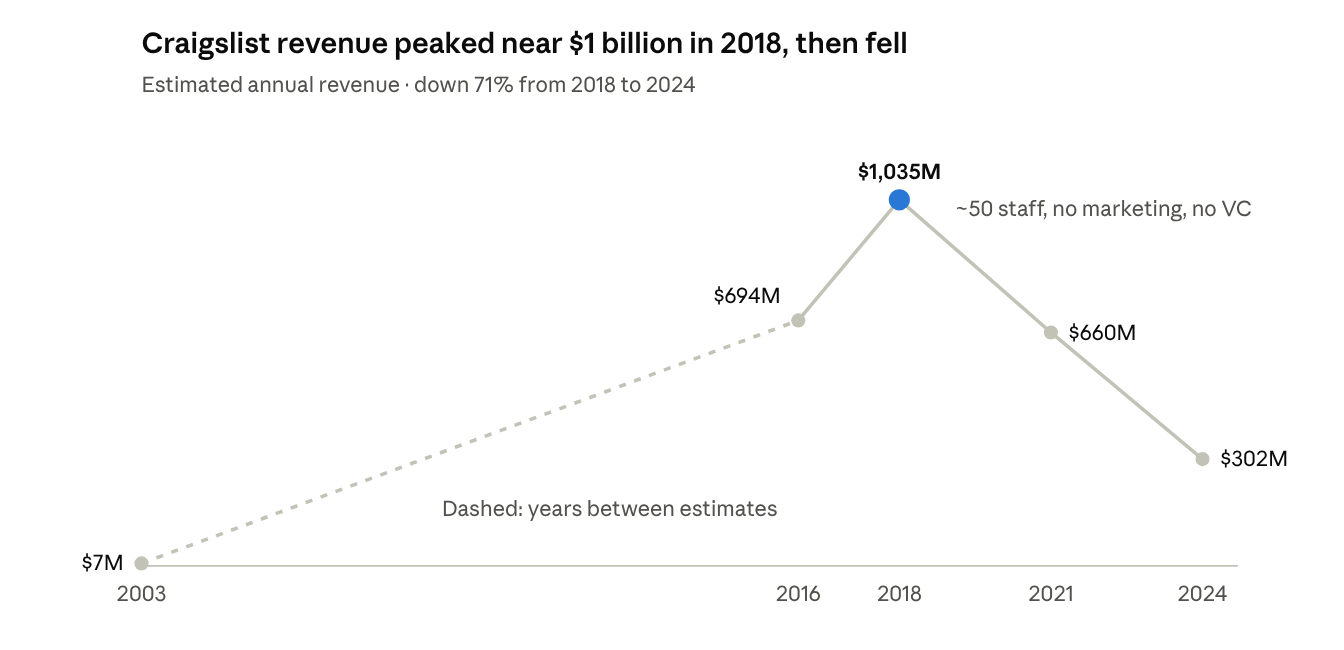
Through all of it, Craigslist kept the same plain, blue-link design that made it famous, and quietly became one of the most profitable companies on the internet. In 2018, the AIM Group estimated Craigslist crossed $1 billion in annual revenue, mostly from paid job posts. It did that with a staff of roughly 50, no marketing budget, and not a dollar of outside capital. “Craigslist is a bigger gold rush than the original 1848 California Gold Rush,” said Peter Zollman, whose firm made the estimate. Then he added that it “does very little to maximize its income.”
That same year, Craigslist was operating in about 70 countries, and by CNBC’s count, it was the biggest classifieds website worldwide. At the end of the year, Newmark retired from Craigslist. Customer service, he said, didn’t need him anymore.
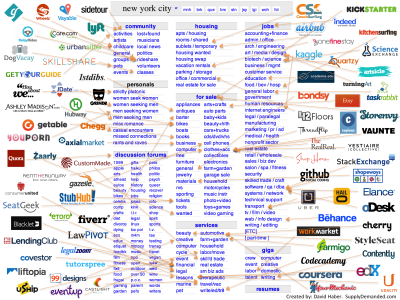
But while Craigslist stuck to its simple formula, other companies saw opportunities to build better products around individual categories. Investors called it the "unbundling of Craigslist": taking the different services offered on one website and turning them into specialized businesses. LinkedIn and Indeed built businesses around jobs. Zillow and Airbnb tackled housing. Facebook Marketplace and OfferUp focused on buying and selling. Features like verified profiles, seller ratings, and more tailored experiences gave people reasons to use these newer products.
Craigslist remained largely unchanged as these companies grew. By 2024, its annual revenue had fallen to an estimated $302 million.
But Craigslist was still a highly profitable business with a small team, still free for almost everyone, and still operating in about 70 countries. Newmark had built something enormously valuable without trying to maximize its value. Other founders saw the opportunities he left on the table and built companies around them.
Newmark's Giving Pledge
Newmark has spent the years since giving away the fortune that once earned him a spot on the Forbes billionaires list. He transferred his remaining Craigslist shares, valued at nearly $400 million, into a nonprofit he jokingly calls his “Septuagenarian Fund.” Then, in December 2025, he and his wife, Eileen, signed the Giving Pledge, a commitment to give away the majority of their wealth.
By 2026, Newmark had donated more than $500 million, primarily to cybersecurity, veterans and military families, and trustworthy journalism. And yes, pigeon rescue. His philanthropic organization, Craig Newmark Philanthropies, has no employees. Newmark himself works as a contractor, relying on outside help for accounting, legal, and communications.
He approaches philanthropy much like he ran Craigslist: keep things simple, find capable people, and let them do their jobs. “I find the group, fund them, nudge them to work together, and get out of the way,” he wrote in his Giving Pledge letter. As he explained on X: “I realized my own cluelessness in this world, that I didn’t know what I was doing, so without thinking about it too much, I started to apply what I learned at Craigslist.” He closed the post with “A nerd’s gotta do what a nerd’s gotta do.”
Building on his own terms
Craig Newmark has always had a different idea of what success looks like. He turned down billions to keep Craigslist mostly free, handed off the CEO job to someone better suited for it, and is now giving away much of the fortune he accumulated along the way.
His story also challenges a common assumption about solo founders: that building alone means doing everything yourself. Newmark started Craigslist without a co-founder, but he knew his limitations. He brought in people who were better at the things he struggled with and spent eighteen years doing the work he was actually good at. And because he never raised venture capital, he had the freedom to make decisions that most founders would have a hard time justifying to their investors.
That's what makes his story interesting for anyone building a company on their own. You don't need a co-founder to build something big, but you do need to know when to ask for help. And you don't have to build the kind of company everyone else thinks you should.
"Ideally I would be remembered because I was really funny," Newmark once said. "But I'm not."
He may not have gotten his wish, but he built one of the most influential websites in internet history. And he did it his way.
Solo Founders Program
Apply for our February Cohort
"I don't feel like a solo founder here. Here I effectively have five co-founders — available when it matters, while everyone still runs their own company."