Should You Raise Money as a Solo Founder?

Key Takeaways
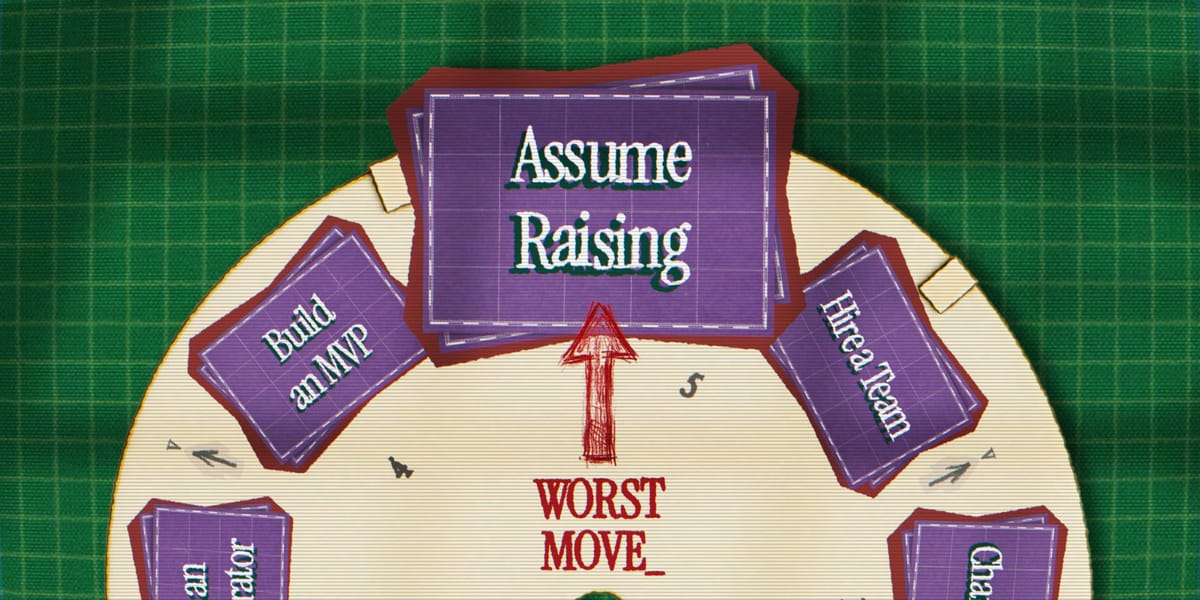
- Raising is a choice, not a default. "One of the worst things you can do is just assume that you should raise money."
- A check comes with an outcome attached. Most investors, Julian says, are now asking whether something is "going to be a $100 billion company."
- A waitlist is not demand. "People put their emails onto things all the time." Ask them to prepay, and the fundraise gets easier.
- Some investor offers are a reason to leave. A promised accelerator slot and a board chair at the idea stage: "run, don't walk."
- You can start before you can code. "In most cases, you probably can vibe code your way to first paying customers."
Listen: Apple Podcasts | Spotify
Introduction
Julian Weisser runs a program that invests $100,000 in solo founders. On this episode he said that one of the worst things a founder can do is assume they should raise money.
He was answering the last of seven questions, each a place where a solo founder is stuck. Five came from founders. Two were scenarios the team wrote. Three of the seven turned out to be about money: whether to raise in order to hire, when to walk away from an investor, and what to do when investors want a bigger company than the founder does.
His answers to all three start in the same place. Raising is a decision about what kind of company you are agreeing to build, and it deserves to be made on purpose. The other four questions get the same treatment. He rarely gives the answer the question is fishing for. More often he checks whether the founder has the right problem.
Raising commits you to an outcome
The seventh question was a scenario. A founder makes $15,000 a month from a business they run alone. Investors ask how it becomes a $100 million company. Is the founder thinking too small, or letting someone else's ambition set the plan?
Julian started by correcting the number. Most investors today, he said, are "probably rightfully asking whether or not something's going to be a $100 billion company." Many only look at companies they think can reach that scale. Whether that is good or bad is beside the point for the founder. What matters is that investors care about how big the thing can get, "and that is sometimes opposed to what the founder wants or what the founder needs."
"One of the worst things you can do is just assume that you should raise money."
The better starting point, he said, is to understand what you actually want. He thinks most people do not know. Some are chasing the approval of friends who started venture-scale companies. A founder who takes the check has signed up for the investor's outcome, so the question to settle first is whether it is also theirs.
Raise when you can say what the money unlocks
Chaitra has hundreds of people on a waitlist, cannot move fast enough alone, and worries that raising money to hire would take months away from customers.
Julian's test is whether you can say what the hire unlocks. He described a company he works with that knows what each new account executive is worth to it. A company in that position has a fundraising story already and will not spend months on the raise. A founder who only feels short on building capacity, without customer momentum behind it, has less to go on.
Then the simpler move: ask the waitlist for money.
"People put their emails onto things all the time. It doesn't mean that they're going to convert."
A deposit might pay for the hire. If people put money down, it also shows an investor that the pull is real.
An offer to walk away from
One question was anonymous. A founder had been offered a small investment. The deal also asked for extra equity in exchange for mentorship, made the mentor chair of the board, and came with a promise of introductions and a place in a top accelerator. The founder worried that saying no to someone so connected would hurt.
Julian had spoken with this founder before the recording. Advisory shares, he said, are not the problem by themselves, and neither is a low valuation for people who help early. The problems are the other two terms. No accelerator works that way, "and anybody who's claiming this is a liar." And the board seat is worse.
"The founder is giving up control of their company before they have anything."
His advice at the time was "run, don't walk." The founder did.
Where vibe coding actually stops
The first question came from Jenna, a non-technical solo founder who does not write production code. Where should the line on vibe coding be, and what does a founder need to understand personally before shipping something other people depend on?
Julian answered the question underneath it first. "Before you build something that people depend on," he said, "you find out that they actually want it."
His order of operations is interest first, then how strong the interest is, then the product. A founder can get through the first two without building anything people rely on, and can now get to a usable prototype as well. People understand when they are using an early version.
So the line he draws is about consequences. "The real question is, how severe is the downside of the app not working? Does somebody die? Is it really a big deal if the app doesn't work? Or is it an inconvenience?"
He names one thing a first-time builder may not think of: backups, in case the data disappears. Beyond that, his read is plain.
"In most cases, you probably can vibe code your way to first paying customers."
Bringing someone on comes later, and gets easier the more the founder has proven alone. What you can prove to yourself is what you can prove to someone you want on board.
The premise might be wrong
Mike's app helps campers book hard-to-get campsites. The customers, Mike said, do not want to tell anyone about it, because every referral is competition for the same site.
Julian was skeptical. How often is someone booking the same campsite on the same weekend as the friend they told? The bigger issue is that Mike had assumed referrals were the channel. "I'm questioning whether or not this is actually the reason that referrals are not happening. And I'm also questioning whether or not referrals are the best channel."
He offered one cheap alternative for founders just getting started on X: like posts from people who care about your problem, and put something compelling in your bio. "You have no idea how well this works for people."
Displacing something, or creating something new
Patrick's question, as written: one commercial real estate customer pays $20,000 a month for a high-touch AI legal product. The other path is a self-serve version at around $1,000 a month for firms with no in-house lawyers. Which business deserves the next year?
Julian would not pick. He gave a way to look at it. A firm that never had legal help is buying something that did not exist at a price it could pay. "Are you actually displacing something, or are you creating something new?" The second can be greenfield.
The larger contract has its own logic. Customers who pay more are often better customers, because they are used to spending. A large buyer may also have people who feel threatened and have to approve the purchase.
Don't settle for kind of working
The sixth question was a scenario: AI makes every idea cheap to try, so a founder has changed direction three times in a month and shipped each time. Is that learning, or avoiding the hard part?
Julian turned the usual advice around. The common story is that startups die because founders give up too soon. He thinks more of them die because the founder stays with something that never turns into the real thing.
Solo Founders has two terms for this. Pulling the thread means each move follows from what the last one taught you, so the changes are connected and not random. Sitting in limbo is treating a decision as permanent when it is not.
"If you take three weeks to make a reversible decision, you are robbing yourself of multiple weeks of potential learnings."
He pointed to founders in the program who are a year in and growing fast. They had paying customers along the way. They kept going anyway. Had they settled for the thing that was kind of working, he said, the world would have passed them by.
Make something of yourself
Julian came back to the seventh question to close the episode. The program focuses on founders who want to go very large, he said, because it has to focus on something. That is a choice about who it serves and carries no judgment of anyone else.
"You might just be ambitious in another part of your life."
Art, books, a family. He closed on an essay of his, "Make Something of Yourself": build the thing that is an expression of who you are, and you find out who that is while building it. Whether to raise money follows from that answer.
About Julian Weisser
Julian Weisser is the founder of Solo Founders and the host of the Solo Founders Podcast. He works directly with every company in the Solo Founders program, and before that spent years building On Deck's founder community. By his own count on this episode, that is seven years across both of watching early founders decide what to build and when to change course.
Subscribe to the Solo Founders Podcast on YouTube, Apple Podcasts, or Spotify.
Join our newsletter for weekly insights from solo founders: https://solofounders.beehiiv.com/
Have a question for Julian? DM @solofounders on X. And if you are building alone and want to do it alongside other solo founders, apply to the program.