He Quit Uber, Beat ChatGPT At Harvard, And Went Solo Building AI | Rahul Sonwalkar (Julius AI)

Introduction
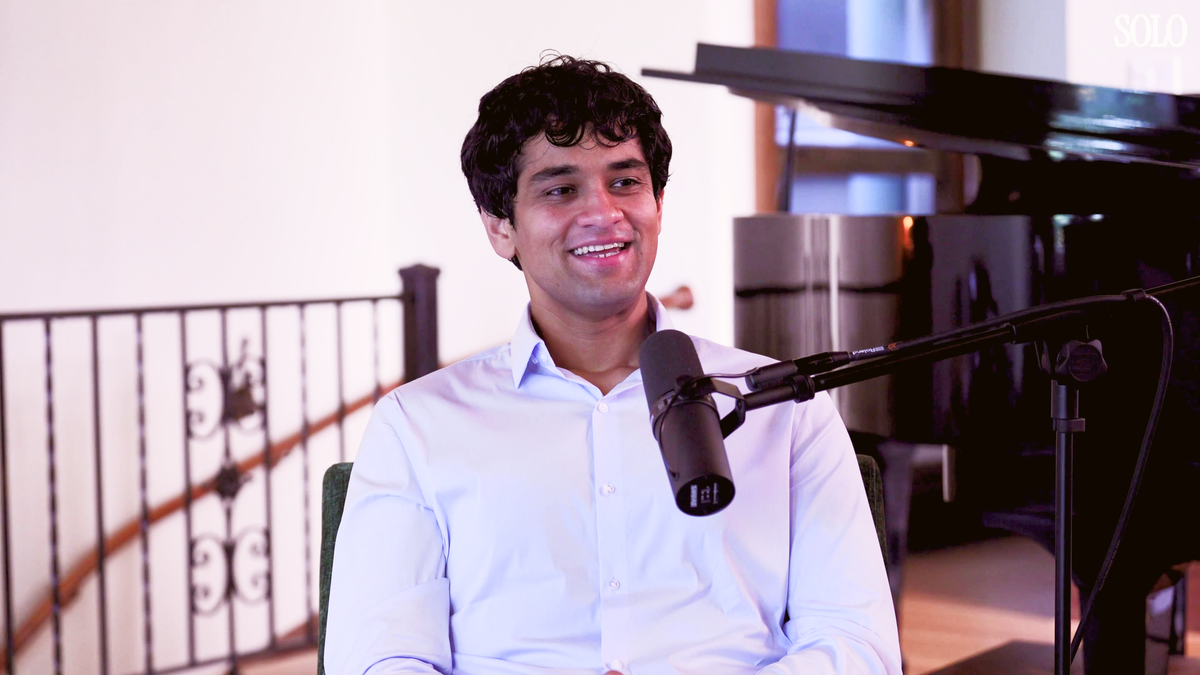
Harvard Business School benchmarked Julius AI head-to-head against ChatGPT for its required "Data Science and AI for Leaders" MBA course. Julius won. All 935 first-year HBS students now use it to analyze data in plain English. The product has over two million users. It's backed by Bessemer Venture Partners. And it was built by one person.
The best founder-origin stories are never the clean ones. Rahul Sonwalkar's path to building Julius AI involves six pivots, a year of Covid-era mobile apps built on the side of his Uber engineering job, a cease-and-desist from Microsoft for calling a product "Excel Copilot," and a US Census query demo that went viral on day one and died on day two. What's striking when you talk to him isn't the product. It's how early he had the discipline to stop chasing the co-founder he thought he was supposed to have.
Rahul started his second company with a couple of friends from college. Within a few months, they told him startups weren't for them. He didn't pause. He didn't go back into co-founder matching. He kept moving. As he put it in his conversation with Julian: "I have this idea in my mind and I just want to go build it. And I don't want to let a co-founder be a blocker for that." That framing is almost the entire episode.
Listen: YouTube | Spotify | Watch on X | Apple Podcasts
The Co-Founder Trap
There's a version of the solo-vs-co-founder debate that gets stuck on equity splits and dilution math. Rahul isn't interested in it. What he keeps seeing is smart, competent people getting blocked for six or twelve months by the search for the "right" person. They're not building. They're not talking to customers. They're aligning with a stranger on a space, then a problem, then a solution, and the moment one of those alignments wobbles, they're back at square one.
"Eight out of ten people that have co-founders, when I talk to them in private, are trying to work through some issue. In their head they're pretty clear about the direction — but then their biggest blocker is, 'I have to align with my co-founder.'"
The great co-founder pairing exists. Rahul calls it a superpower. But it's rare, and most people don't have it — they have the appearance of it, then stall out the first time they disagree. His advice is blunt: get started, start making progress, and see if you meet awesome people along the way. Momentum attracts momentum. A blank slate attracts nothing.
Startups Are a Game of Outliers
One of the most quietly contrarian lines in the conversation is Rahul's observation that every piece of generalized startup advice pulls you toward average. Great outcomes are outliers, outliers don't look like the mean, and the mean is what best practices optimize for.
"If you're following all the conventional wisdom and all the best practices, you're going to end up being very average. Each great startup ends up violating a few of the conventional wisdom of startup rules."
His examples: Rippling didn't start with an MVP — they launched across payroll, insurance, laptop management, and HR simultaneously. Figma took forever to launch and forever to monetize. Cursor hit PMF in weeks. What this means, Rahul argues, is that you have to get good at saying no to advice. Most advice comes from someone projecting their wishes into your situation — and your situation is almost always different.
Six Pivots and a Cease-and-Desist
The most fun part of the conversation is how Rahul actually got to Julius. It started during Covid. He was an Uber engineer building mobile apps on the side. His plan: build until something clicked, then go all in. Nothing clicked. He was tired of waiting. So he quit anyway.
The company he started had a loose premise: GitHub Copilot had just begun working, and he wanted to know if the same underlying idea could apply to writing queries and analyzing data. He had no product — just a direction. Six pivots followed. Three months trying to sell AI into logistics companies. A general tool called Excel Copilot, killed by a cease-and-desist letter: "You're calling your thing Excel Copilot. That's double bad. Both of our trademarks." Then the US Census demo, which had a ton of users on day one and nobody on day two because "people don't have questions about the US." Four more months of dataset experiments until the through-line revealed itself: the thing people actually care about analyzing is their own data, especially work data. They built that, and it became Julius.
"The first pivot is the hardest — you've told everybody you're going to work on this idea. But once you get past the first pivot, you're free to fail again."
Julian, riffing on Julius AI's logo, suggested that building a company is like revealing a sculpture in a block of marble — you don't see the figure for a long time, and then suddenly you do. Rahul loved it. His reality check: go look at the archived versions of Figma, Zapier, or OpenAI's first websites. They all look like hackathon projects. The final form is earned, not presented.
Convincing Is the Job
If there's a one-sentence version of this episode: the real job of a founder is convincing people. Investors, customers, early hires — and then your team has to convince the next wave on your behalf. Charisma is not the bottleneck. Conviction is.
"I don't think Sam Altman can sell me a pen. But he can convince me of AGI."
It takes the most famous sales cliché in the world — "sell me this pen" — and inverts it. Real sales isn't about closing a random object. It's about having such deep, almost delusional conviction in something that the explanation comes out clean on the other side. Solo founders who don't love the act of convincing should probably not be solo founders at all.
Hiring, Culture, and the Worst Coder on the Team
Rahul has a simple hiring rule most founders agree with and almost none follow: at every function, he wants to be the worst person on the team. He used to be an engineer. Now every engineer at Julius is better than he is. Solo founders can't split the surface area the way co-founded teams can — you can't hand product engineering to your CTO — so you have to find multipliers who take direction and execute without waiting for the next instruction.
This cascades into equity. Solo founders, he argues, should be more generous with early-team equity, not less. With no alignment burden, you have more equity to work with. One signal he looks for: if a candidate asks for less cash and more equity, that's a big green flag.
Culture is the other thing solo founders underestimate. When you're two, your first hire is 50% of the company. When you're three, your team is 66%. Whatever culture you set at four is the culture at twenty. Rahul's filter, borrowed from Peter Thiel's advice to Mark Zuckerberg: hire people you actually like spending time with. The culture at Julius is an extension of who Rahul is — hacker-oriented, ship-in-a-day, heavy on memes and jokes about the CEO. "There's no HR-approved memes channel. There's just memes."
The Bear Case and the Bull Case
Julian closed the conversation the same way he closes most episodes. The bear case is short. Don't be a solo founder if you don't love convincing people. Don't do it if you're looking for a job where people listen because you told them to. Don't do it if you can't handle the loneliness of a solo CEO — which Rahul argues is unlike anything else — or the burnout of being the sole bottleneck for recruiting, marketing, and product simultaneously.
The bull case is cleaner. It's incredibly low friction to get started. No co-founder matching, no work trials, no aligning on three levels of abstraction before you build anything. And when the critical decisions come — a pivot, a direction, a key hire — you can just make them.
"I've met countless people that are really smart, really competent, and they're blocked on starting a company because they don't have a co-founder. I hope the work you're doing destigmatizes solo founding."
About Rahul Sonwalkar
Rahul Sonwalkar is the solo founder and CEO of Julius AI, a natural-language data analysis platform that lets anyone analyze data in plain English. Harvard Business School benchmarked Julius against ChatGPT and picked it for the required "Data Science and AI for Leaders" course, where it's now used by all 935 first-year HBS MBAs. Julius has over two million users and is backed by Bessemer Venture Partners. Before Julius, Rahul was an engineer at Uber working on logistics data, and spent a year of Covid building mobile apps on the side. He quit to go all-in, then went through six pivots — logistics AI, Excel Copilot (which drew a cease-and-desist from Microsoft), a US Census query tool, and several others — before landing on Julius.
Subscribe to the Solo Founders Podcast on YouTube, Spotify, or Apple Podcasts.
Join our newsletter for weekly insights from solo founders.