From 500 Rejections to a $300M Company: Paul Klein IV on Solo Founding Browserbase
Solo Founders Podcast — Episode 2 with Paul Klein IV

Key Takeaways
- Decisiveness is the solo founder's superpower — one decision maker means the company moves faster
- As a “five‑tool founder” (product, sales, fundraising, hiring, operations), Paul could viably go solo on his second startup.
- Solo founding wasn't his first choice. Paul tried to find a co-founder and couldn't, then embraced the path
- Paul believes first-time founders shouldn’t be solo founders.
- Emotional vulnerability, second chances, and non-traditional backgrounds form the cultural backbone of a 50-person startup
Listen: YouTube | X | Apple Podcasts | Spotify
Introduction
Paul Klein IV applied to 500 internships. He got rejected from 498.
Today, he's the solo founder and CEO of Browserbase, the headless browser infrastructure company that lets AI agents interact with the web. A suite of products the likes of Perplexity and Vercel use (along with over 1,000 others). Browserbase has raised $67.5M through its Series B at a $300M valuation and has grown to nearly 50 employees in under two years.
In this conversation, Paul broke down the full arc: from getting pulled into his first company during a 72-hour coding binge, to methodically validating Browserbase through a 3,000-word memo, to trying (and failing) to find a co-founder, to building one of the fastest-growing infrastructure companies in AI. He was brutally honest about why you shouldn't be a solo founder, and then explained why it's been the right decision for him.
The Five-Tool Founder
Paul borrows from baseball to describe what made him comfortable starting Browserbase alone. In Moneyball, scouts look for the rare "five-tool player," someone who can hit for average, hit for power, run, throw, and field. Paul sees a parallel in solo founding: "I do think I am a five-tool founder where I can do soup to nuts, everything you need to do."
His five tools: product, sales, fundraising, hiring, and operations. He built the product. He got on Twitter and talked about it. He sold. He fundraised. He even ran payroll, because he'd done all of it at his first company, StreamClub.
That's also why Paul is emphatic that first-time founders should not go solo. The first time around, you don't have those tools yet. You're still learning what Delaware Franchise Tax is.
"I still 100% believe that first-time founders should not be solo founders, mostly because I was so dumb as a first-time founder. I mean, you make so many mistakes. You shoot so many of your own foot guns."
The learning curve of a first startup is so steep that having a co-founder isn't a luxury, it's a survival mechanism. The five-tool founder is only possible after you've played through a full game once.
From StreamClub to Browserbase
Paul's first company started the way many first-time startups do (accidentally). He came home frustrated on a Friday, a friend messaged him about a side project, and what followed was a 72-hour coding binge. They launched on Product Hunt on Monday and hit #1 product of the day. This was March 2020, right as COVID was making virtual events the only events. StreamClub was eventually acquired by Mux in 2021.
The second time was nothing like the first. Where StreamClub was spontaneous, Browserbase was deliberate. During his time post-acquisition, Paul had been writing monthly about startup ideas. One of those pieces became a 3,000-word memo called "Internet Browser for AI," laying out the case that AI needs browser infrastructure. When prospective customers wanted to angel invest in the company, he knew he had something real.
But here's the part that surprises people: Paul didn't choose to be a solo founder. He tried hard not to be one.
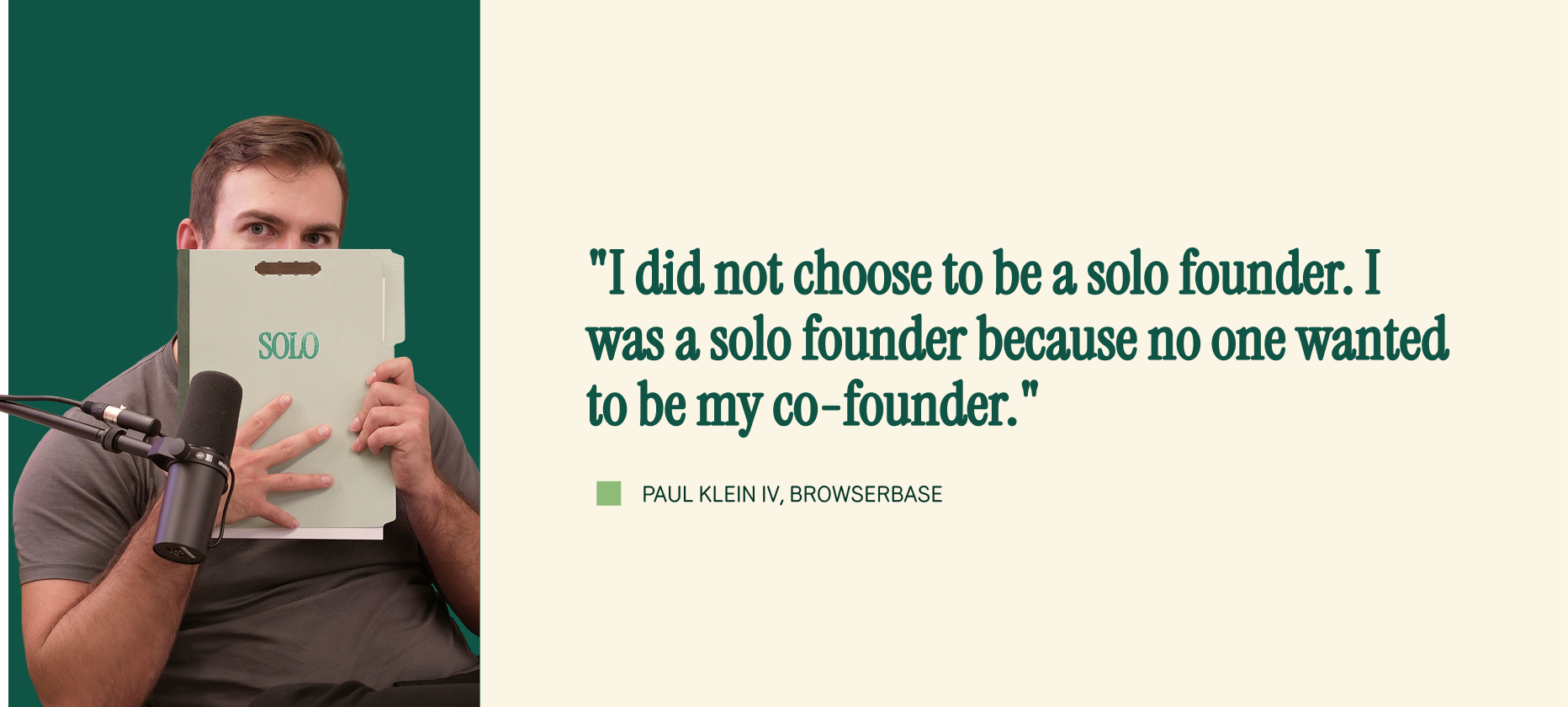
He went through the co-founder dating process, asked several people, gave out the co-founder title. He even offered to be CTO and let someone else be CEO. Nobody took the role. So he started alone, and it turned out to be the right decision. The clarity of one decision maker, the direct alignment between founder and company, the speed of not having to re-explain or re-align with a partner.
Company Culture: The Mirror of Your Flaws
As a solo founder scaling to nearly 50 people, Paul has had to be extraordinarily intentional about culture. There's no co-founder to share the load of being the cultural carrier. The company reflects him, for better and worse.
"People often say that your company becomes a mirror of your flaws as a founder. That's totally true," he said.
Paul built Browserbase's culture around three pillars from his own experience. First, emotional vulnerability. Browserbase is, in his words, "an emotionally vulnerable company." If someone has beef with a colleague, they hash it out in person. Paul has gone to employees' apartments to hear them out when they're upset. The logic is straightforward: politics come from grudges, grudges come from misunderstanding, and the whole chain gets cut at the source when people acknowledge their irrational feelings.
"We're an emotionally vulnerable company. If you have beef with somebody else at this company, we're dealing with that beef."
Second, second chances. Paul got his break when a tech lead at Twilio pulled his resume from the pile for no particular reason. He builds his company the same way. People are allowed to make mistakes, expected to even. The condition: you don't make the same mistake twice.
Third, non-traditional backgrounds. Over 25% of Browserbase employees relocated to San Francisco for the job. Many come from backgrounds traditional tech companies would overlook: no CS degree, state schools, different industries. Paul hires from "the other category" on purpose, because that's where he came from.
From Quarterback to GM
Paul describes the evolution of a solo founder CEO through three phases.
Phase 1 — Quarterback: Writing code, hiring, selling, doing everything. A small team around him, but he's calling every play.
Phase 2 — Head Coach: Still deeply involved but coaching rather than doing. Developing the team rather than carrying it.
Phase 3 — GM: Sitting in the skybox. Setting grand strategy, bringing in talent, getting out of leaders' way.
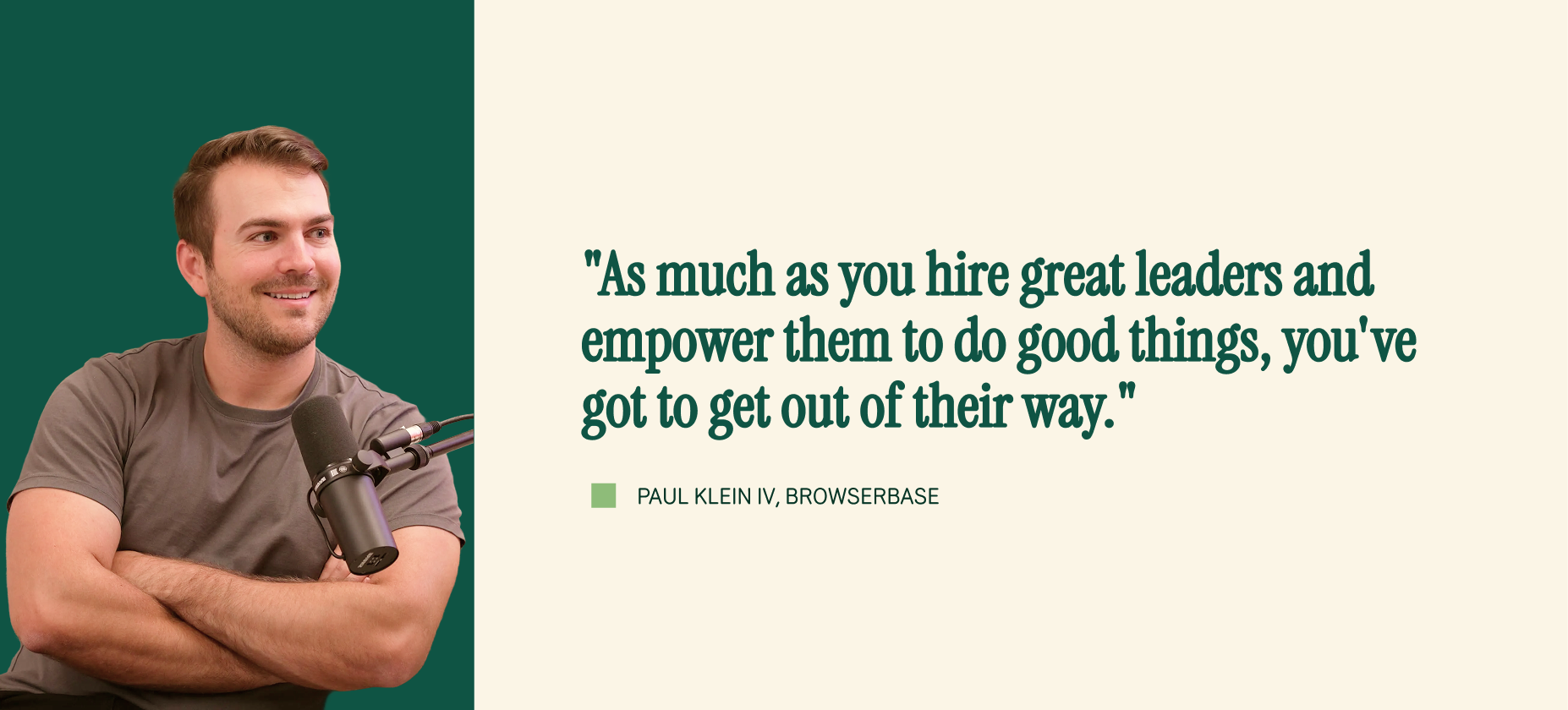
Paul estimates the emotional runway for a solo founder working at maximum intensity is about two years. By 18 months in, with 25 people in the company, it's time to build a leadership team or risk burning out. He learned this firsthand when he took on 35 direct reports for a quarter to get into "founder mode" on engineering — and realized he's a bad manager past 10 people.
The Case For and Against Solo Founding
Paul delivered the bear case directly to camera, and he didn't hold back.
"Being a solo founder is not worth it. You're going to get fat. You're not going to see your friends. You're going to have no life whatsoever, and your startup probably won't work out statistically."
You can't take a sick day without the company stopping. You can't share the full context of your problems with anyone who truly understands. Every hard thing lands squarely on you.
"Starting a company is a means of last resort," he said. "If you're doing this thing, it's because you have no other options."
And then the bull case, delivered with equal conviction. Solo founding has given Paul clarity he wouldn't have with a co-founder. The alignment between him and the company is direct, one layer, not two. There's no ambiguity about whose insecurity is creating which hedging behavior. And it's created more room for the team: without a co-founder absorbing responsibility, team members step up to fill gaps they can see.
"There's one decision maker, and decisiveness drives highly effective companies. If you can make quick decisions, you can move faster than other people."
About Paul Klein IV
Paul Klein IV is the solo founder and CEO of Browserbase, the cloud infrastructure platform that lets AI agents interact with the web through headless browsers. Before Browserbase, Paul was CTO and co-founder of StreamClub (a virtual event platform acquired by Mux in 2021) and spent three years as a software engineer at Twilio during its IPO era. A self-described "five-tool founder" who went to SF State and got rejected from 498 of 500 internship applications, Paul has turned Browserbase into a nearly 50-person, Series B company in under two years, with customers including Perplexity, 11x, Commure, and Vercel.
⸻
Subscribe to the Solo Founders Podcast on YouTube, Spotify, or Apple Podcasts.
Join our newsletter for weekly insights from solo founders.