"ChatGPT Can Be Your Co-Founder": Dave Morin on Solo Founding as a Relational Act

Key Takeaways
- Solo doesn't mean alone. The one way solo founding fails, in Dave's telling: "The bear case is that you believe that solo founding means literally being alone and talking to AI. This will not lead you to a good place." Founding is a relational act.
- The co-founder gate is gone. "When I first got here, YouTube didn't exist. Today, YouTube can be your co-founder. ChatGPT can be your co-founder. OpenClaw can be your co-founder."
- Most startups die on relationships, not product. "Not because the product idea was bad or the market wasn't there." The band breaks up, and you don't get to hear the music anymore.
- Design the team like you design the product. What Jony Ive told Dave when Steve Jobs died, and how it applies to a founder with no co-founder: you're still in massive collaboration, with collaborators and with customers.
- You'd better love it. "You're going to have to do 10,000 dinners about it." The filter Dave uses for what to back, and what to build.
Listen: Apple Podcasts | Spotify
Introduction
Three months before Polsia existed, Ben Cera sat on a couch in Mill Valley and asked Dave Morin whether he was crazy. He was living in Kyoto, Hong Kong, Shanghai, and Thailand, building a different company, and halfway through he'd built something else: AI agents to keep himself company. A CMO. A VP of Engineering. A therapist. He called it Company OS. He'd built it because he was lonely.
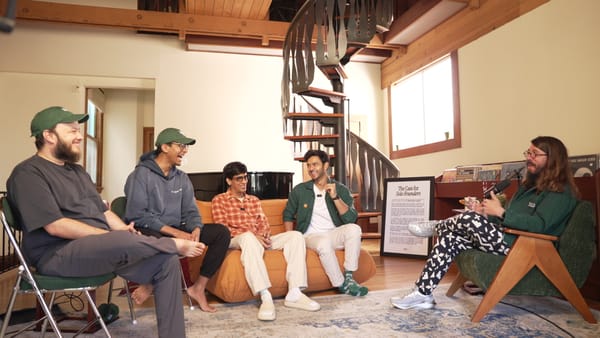
"No, man," Dave told him. "You're just halfway through an album, and you've got to keep going." Ben said, right then, that he would have quit otherwise. The agents became the product. The product became Polsia, the one-founder, zero-employee company that raised $30M at a $250M valuation this spring, with Offline Ventures on the cap table. Ben was the first guest on this podcast. Dave was on the other end of the couch.
He has been on the other end of a lot of couches: Apple, then the team that launched Facebook Platform, then Path, Slow Ventures, and now Offline Ventures, the Mill Valley fund with a studio attached. In December 2025 a friend told him to install something called Clawdbot; within a day he was tracking down its creator, and today he chairs the OpenClaw Foundation. Julian opened this conversation by reading him the inside cover of The Alchemist, and what followed was the most complete case yet recorded on the show for one idea: you can start alone, you should, and "solo" has never meant what the fear says it means.
A Producer, Not an Investor
Dave is from Montana, and his friends there ask him what he does. His answer is not "venture capital."
"I actually think of myself as a producer, not an investor. It's easier to explain what I do in the context of music than in technology."
The analogy is the Behind the Music shot: an artist in the booth, someone behind the soundboard. It changes what he watches for. "Most startups fail because the relationships don't work out. Not because the product idea was bad or the market wasn't there." Bands break up, and the music stops. "I think oftentimes that's what's happening behind your favorite apps."
It also changes how long he stays. "This might be the first one, but you're probably going to do three more, and I want to invest in all of them." He backed Ben Cera's first company in 2010 or 2011. Fifteen years later, that patience produced Polsia. "Nobody ever does podcasts about the ghosts," he says of the companies that fail. The producer's job is to be there for the second album.
The Design of the Team
"None of us grow up alone," Dave says. The best founders keep searching for the next great collaborator instead of closing up. When Steve Jobs died, Dave was building Path and talking with Jony Ive, who told him, as Dave recounts it: "Dave, the design of the team is as important as the design of the product." For a solo founder this is not a contradiction. It is the instruction. "You can be alone, you can be a solo artist, but you're always going to be in massive collaboration — not just with the creatives around you, but ultimately with the customers." The relationships, in Dave's phrase, are the product.
Twelve Hours With Clawdbot
The OpenClaw story is usually told from Peter Steinberger's side. Dave's side starts with a solemn holiday in Montana, unsure what 2026 would bring, and a message from a friend in a late-'90s group chat: you've got to check out this Clawdbot thing. He ignored it for a day. Then he installed it.
"Within less than twelve hours I had this feeling that I hadn't felt since I was a little kid — when I was seven years old and my grandfather gave me a Macintosh computer."
That Macintosh is still on his childhood desk. The only other time he'd had the feeling was seeing Facebook from inside Apple. He did the same thing again: found Peter, DMed him on Twitter, then iMessage, then every day. "We need to protect it at all costs. I don't know if it's a company or a movement or what, but I would love to help." OpenClaw is now a foundation with, as Dave puts it, "more people contributing than most of the labs have employees," and he is its chairperson.
He is careful about why Peter could move so fast. A decade of "really hardcore engineering" at PSPDFKit meant Peter knew macOS at a level most people don't. "This is an artist who understood all of the materials." The speed was not the tools. It was practice meeting the tools.
10,000 Dinners
Julian asked why so many startups now feel derivative, and whether AI is making that worse. Dave agreed, and offered a filter. His example was Matt Oesterle, founder of Ramble, who is building elevated campgrounds on land near national parks, chosen with data, one county zoning board at a time. "It's entrepreneurship on PhD mode." Matt is also a serious mountaineer; Ramble is an expression of that.
"Whatever it is you're doing, you'd better love it. You'd better be the most passionate about it in the world. … You're going to have to do 10,000 dinners about it in order to get there."
Build for the App Store charts, or for "some unknown customer you have absolutely no connection with," and "you will almost always fail." Polsia, OpenClaw, and Ramble share one thing: a founder expressing something they already know.
The Bear Case, and the Case for Going Solo
Julian's closing two-parter got its tightest answer yet. Dave's bear case is aimed at exactly the reading of "solo founder" that the AI era invites:
"The bear case is that you believe that solo founding means literally being alone and talking to AI. This will not lead you to a good place."
The greatest musicians still walk into a studio full of studio musicians. Find the investor with the opposite brain who holds you accountable. "Founding is a relational act. So don't go into it thinking you need to be alone, because you will fail."
The bull case splits in two. If you're brand new, the dark art Dave had to learn by mentorship in the early 2000s is now on YouTube, in ChatGPT, in OpenClaw. If you're a second-time founder, "you have the prior version of you as your co-founder." The share of new startups with a single founder has climbed from under a quarter in 2019 to more than a third, per Carta. Dave's closing line is the reason:
"Prototyping has never been easier. Expressing the first version of your idea has never been easier. Accessing capital has never been easier. And it's only going to get easier. So just start."
About Dave Morin
Dave Morin is co-founder and partner at Offline Ventures, the Mill Valley venture fund and studio he started in 2020 with Brit Morin and Apple veteran James Higa, on the premise that "we invest, but we're creatives first." Raised in Montana, he began his career at Apple, then joined Facebook as part of the early team behind Facebook Platform and Facebook Connect. In 2010 he founded Path, the private social network that raised roughly $77M, reached more than 10 million monthly users, and was acquired by Daum Kakao in 2015; he co-founded Slow Ventures in 2011 while still at Facebook. Dave has backed Ben Cera across multiple companies, most recently Polsia through Offline, and is Chairperson of the OpenClaw Foundation. He is also Chairman of the Esalen Institute and co-founder of the Sunrise Foundation, a mental-health nonprofit.
Subscribe to the Solo Founders Podcast on YouTube, Apple Podcasts, or Spotify. Join our newsletter for weekly insights from solo founders: solofounders.beehiiv.com