$20M From Accel & Index to Replace Slack — With No Co-Founder

Key Takeaways
- Agents are locked out of the tools your team lives in. "Imagine you're an agent — you're literally just dropped into this office building that was not built for you… people are referencing stuff in file cabinets that they've locked."
- Pick the market that fits your personality. Sara willed herself into enterprise sales at 19 and hated it for years. "Sometimes people pick the wrong problem or market for their personality."
- Trust runs at different speeds. "Human trust takes a while to gain, and the speed of losing it is fast" — once established it's far more resilient than trust in agents, and interface design is how you bridge the gap.
- Attract, don't chase. Her hiring strategy as a solo founder: build the puzzle in public, make the missing pieces obvious, and let the right people apply themselves.
- Companies have souls. The case for going solo, in her words: "It's probably truest to building a company if you can adapt yourself to it."
Listen: Apple Podcasts | Spotify
Introduction
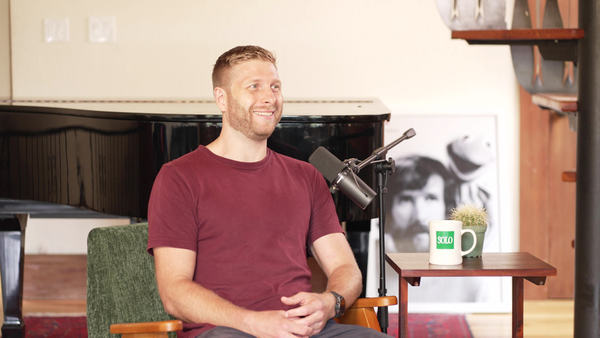
When Sara Du sat down in the studio, her company didn't officially exist. Ando had been heads-down for a year — a founder who built a Twitter following at 16 and co-founded a venture-backed company at 19, working quietly on the least fashionable kind of ambitious software: team messaging. Six days before this episode aired, the quiet ended. Ando came out of stealth with a $20M seed from Accel, Index Ventures, and Emergence Capital, and a claim big enough to earn the round: Slack was built for humans only, and the next era of work — the one where AI agents are coworkers — needs a messaging platform built from scratch.
What makes Sara's version of this story a Solo Founders episode is the second half of the claim. She's doing it alone. Her first company, Alloy Automation, she co-founded with a friend from high school and ran for five and a half years. Ando has no co-founder — a deliberate choice from someone who has now built both ways. In this conversation with Julian, she explains what changed between company one and company two: her motivations, her hiring philosophy, and her conviction that a company is an entity with a soul of its own — one a solo founder can hear more clearly.
The Office Building Your Agents Can't Use
The heart of Sara's pitch isn't a feature list. It's a picture. Ask why agents underperform inside Slack and Teams, and she'll tell you to imagine being one:
"Imagine you're an agent — you're literally just dropped into this office building that was not built for you. You can maybe read the signs. But people are referencing stuff in file cabinets that they've locked."
Slack, she points out, is fifteen-year-old architecture. Agents live there as apps — an install-time concept from an era when software couldn't talk back. They can't discover which channels to join, don't hold real permissions, and can't accumulate the context that makes a colleague useful. Her team's core belief is that most of the world still treats agents as tools when the interesting future treats them as coworkers — with an identity, an inbox, and etiquette. Ando ships details as odd-sounding as an agent tool for compressing its own verbose output into something humans actually want to read — left alone, she laughs, agents report their work in terms that make sense only to them. The platform's job is translation.
The team has run entirely on Ando since January — no Slack — and the early users tell her the thesis is landing in places she didn't expect: teams across a dozen countries, including, memorably, an adventure-sports company in New Zealand that taught her new ways to use her own product.
Sometimes You Pick the Wrong Market for Your Personality
Sara started Alloy at 19, two years after moving to San Francisco through Thiel Fellowship circles. She's honest about how little of that first decision was a decision — she'd simply absorbed the notion that a venture-backed company is what ambitious people start. What followed was five and a half years of enterprise B2B — flying to meet buyers she didn't want to sit with, chasing milestone after milestone without ever asking why this problem was hers.
"Sometimes people pick the wrong problem or market for their personality."
That's the sentence she'd hand any founder standing at the start. Her filter now is embarrassingly practical: which work would you do anyway? She's a builder and, by her own admission, more marketer than salesperson — "it was only clear to me in hindsight." So the second company had to be one whose early motion — building in public, writing, attracting the curious — was the motion she defaults to. Before committing, she took nearly a year off, discovered she couldn't sit still, and set a new bar: not a milestone, but a problem worth ten-plus years of her life. When MCP made agent tooling real, and every consulting client wanted agents inside Slack, she recognized the shape of a problem that clears that bar.
Hiring When There's No Co-Founder to Hire With
The standard objection to solo founding is that co-founders are the first team. Sara's counter is that she was only actually alone for a few months before her first hires — and that hiring as a solo founder forced a better playbook than falling into a co-founder ever did.
"Attracting is sometimes better than chasing. Everyone in the world can see I'm building this puzzle — it's very clear where the missing pieces are, and the right people find it."
Over half her team came through warm ties — one engineer had worked with her for four years across companies — and nearly everyone starts on contract. Not as a hedge: "you can get far more signal," as she puts it, and a contractor's departure isn't a drama — just someone who came to help out for a while. She's become, in her words, extremely minimalist about headcount. Figure out the core of the thing first; it's simply easier with fewer people. The culture that's emerged is distinctly hers — philosophy salon dinners, a team library on the company site, and a teammate who once, unprompted, wrote her a document eliciting her own values from months of observed decisions.
The Case for Going Solo
Julian closed with the show's customary two-parter. Sara's bear case is overthinking: "you don't really have many people you can bounce ideas off of — even very smart people outside the company don't have the full context." It's part of why she made her first hires within months.
The bull case is the line the episode ends on:
"Companies are like entities — they have souls of their own. It's probably truest to building a company if you can adapt yourself to it."
Two people, especially two first-time founders, spend their early years negotiating each other — "that's why so many co-founders end up doing therapy together." Alone, she argues, you hear what the company actually needs, and you can bend yourself to it. Having built both ways, she's not guessing.
About Sara Du
Sara Du is the founder and CEO of Ando, the team messaging platform built for humans and AI agents working together, which came out of stealth in September 2026 with a $20M seed from Accel, Index Ventures, and Emergence Capital. A Thiel Fellow who taught herself to code in high school in Georgia, she moved to San Francisco at 17 and co-founded Alloy Automation at 19, leading it for five and a half years through a $20M a16z-led Series A. Ando is her second company — and her first solo one.
Subscribe to the Solo Founders Podcast on YouTube, Apple Podcasts, or Spotify.
Join our newsletter for weekly insights from solo founders: solofounders.beehiiv.com