
Solo Founders Are Leaving This Hiring Advantage on the Table

For decades, the conventional wisdom about solo founders and hiring has harped on a single note: you're at a disadvantage. They'll say that without a co-founder to share the load, you'll scramble to hire. Without a technical partner, you'll struggle to attract engineering talent. Without splitting equity from day one, you'll have less credibility when building a team.
That’s the reputation. The reality in the data is very different.
In our report featuring exclusive data from Carta, solo founders actually hire their first employee faster than multi-founder companies. They're not scrambling — they're moving with urgency because they have to. And here's the surprising part: they're sitting on an untapped advantage they're barely using.
The Speed Advantage
Solo-founded companies typically bring on their first employee earlier than multi-founder companies. The median time from incorporation to first hire is 399 days for solo founders, compared to 480 days for multi-founder companies. Nearly three months faster!
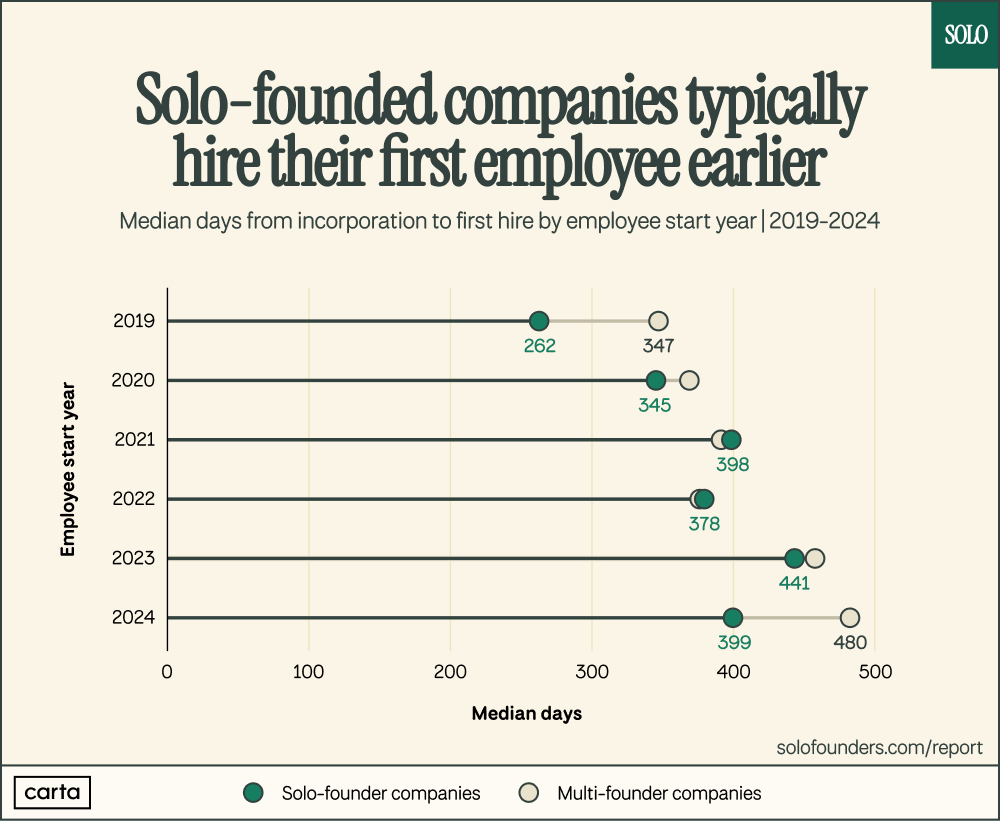
This makes intuitive sense. As Peter Walker (Head of Insights, Carta) observes, co-founder teams start with greater built-in capacity — simply having at least one more person to share the work. Solo founders don't have that luxury. They hire because they have to.
But what looks like necessity has become an advantage. Solo founders who hire early are building their teams while their multi-founder competitors are still operating as a closed unit. They're pushed to source early believers who become deeply invested in the company's mission.
As Rahul Sonwalkar from Julius AI puts it:
You need people who will multiply your efforts — not just execute a delegated task and wait for the next instruction, but take a direction and run with it."
The Recruiting Superpower No One's Using
Here's where the data gets interesting (and frustrating).
Solo founders have a massive structural advantage when it comes to hiring: they have roughly double the equity to work with. While a two-person founding team has already split the company 50/50 before hiring anyone, a solo founder starts with 100%. That's an enormous war chest for attracting top talent.
But the Carta data reveals something surprising: median equity grants for the first five employees are nearly identical across solo- and multi-founder companies.
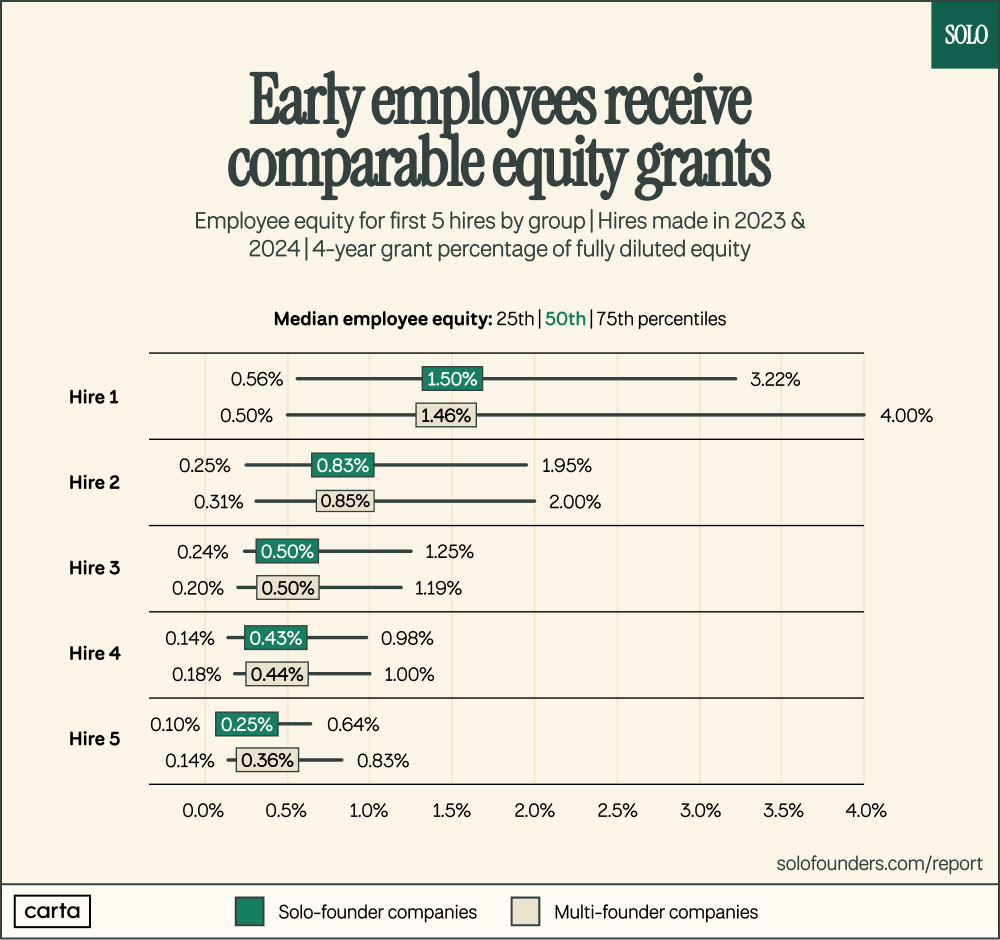
For hires made in 2023 and 2024, the numbers are tightly clustered. First hire? About 1.5% regardless of founding team structure. Fifth hire? Around 0.30% either way. Solo founders aren't using their equity advantage at all.
Charles Hudson from Precursor Ventures finds this baffling:
"I don't think we're as sophisticated about solo founder equity, cap tables, and grants as we are with co-founded companies. They might ask, 'Why shouldn't we give our first or second founding engineer 3%?' and then immediately think, '3% is way too much.' But 3% is only too much in the context of two founders."
The likely explanation? When solo founders look for guidance on equity, they encounter frameworks built for co-founder teams that have already diluted themselves significantly. Those grant sizes make sense when the founding team starts heavily diluted — but they don't reflect the additional leverage solo founders have.
What the Best Solo Founders Actually Do
The median tells one story. The best solo founders tell another.
Most solo founders we've spoken with are far more generous with employee equity than the dataset suggests. In those cases, the additional equity becomes a decisive factor for candidates choosing between otherwise comparable opportunities.
Daniel Francis from Abel Police doesn't mince words:
"The solo founders in this data are being too greedy... They're being penny-wise and pound-foolish, because the quality of the person you can bring in [with higher equity] is so much higher."
The math is simple: if you don't have co-founders, you have double the equity to recruit the best people. In competition for top talent, that's a significant advantage — but only if you use it.
Noemie Federico from the Solo Founders team puts it this way:
"You can tell how good a founder is by talking to their founding engineer. Solo founders always have excellent ones. More authorship and more equity to grant gets you the best people."
Engineering First, Always
Across both solo- and multi-founder startups, engineering remains by far the most common first hire. This reflects the essential need for technical capacity, especially in the AI era, where product velocity is everything.
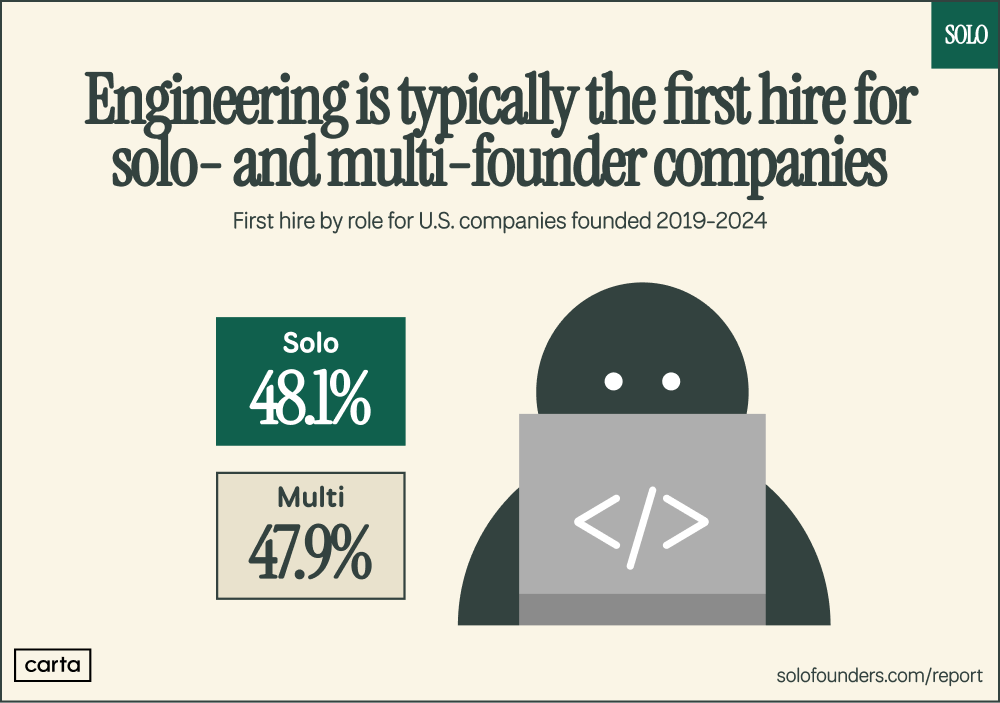
For non-technical solo founders, this hire is existential. Adeel Khan from MagicSchool shares his approach:
"As a non-technical solo founder, my first hire needed to be technical so they could help me build the MVP. I also optimized for people who were deeply committed to the mission, who had skills and talents distinctly different from mine, and were willing to take a risk with me on an early-stage startup."
But technical solo founders face a different challenge. Jimmy Douglas's experience is instructive:
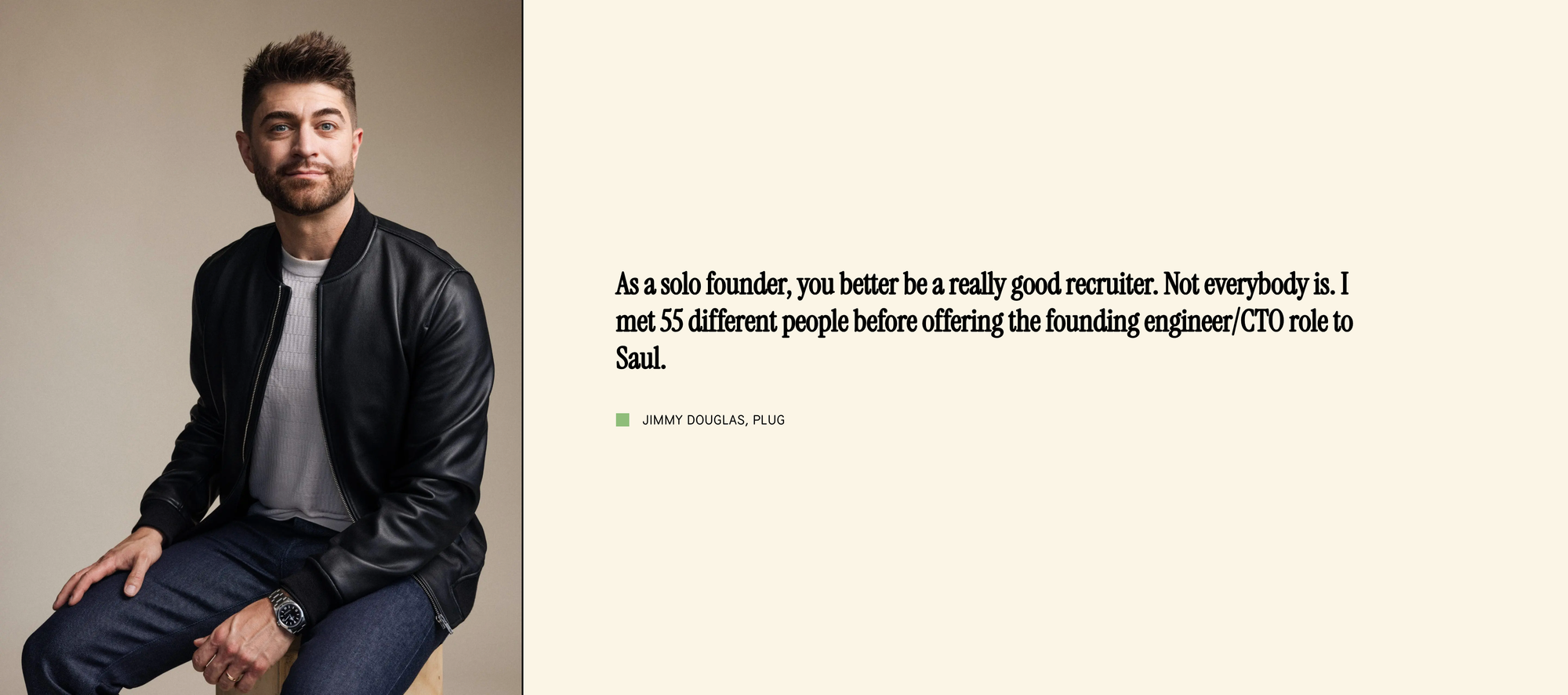
Fifty-five conversations for one hire. That's the level of rigor required when your first engineering hire will shape your entire technical culture.
The Strategic Playbook
Here’s what to do with this data for solo founders building their first teams:
Use your equity advantage. You have more to work with than multi-founder companies. Act like it. The solo founders who win talent battles are offering 2-5x the equity of their co-founded competitors. That's not generosity, it's strategy.
Consider longer vesting periods. If you're giving large equity grants to attract top talent, consider making it over a longer time horizon like 6 years. It's becoming common for co-founders to have longer vesting than 4 years — extend that logic to your key hires.
Hire for multiplication, not execution. Solo founders can't afford people who wait for instructions. Every early hire needs to take a direction and run with it. Screen for autonomy and initiative, not just skills.
Move fast. You don't have a co-founder to share the load. That's not a weakness – it's a forcing function. The data shows solo founders hire faster because they have to. Lean into that urgency.
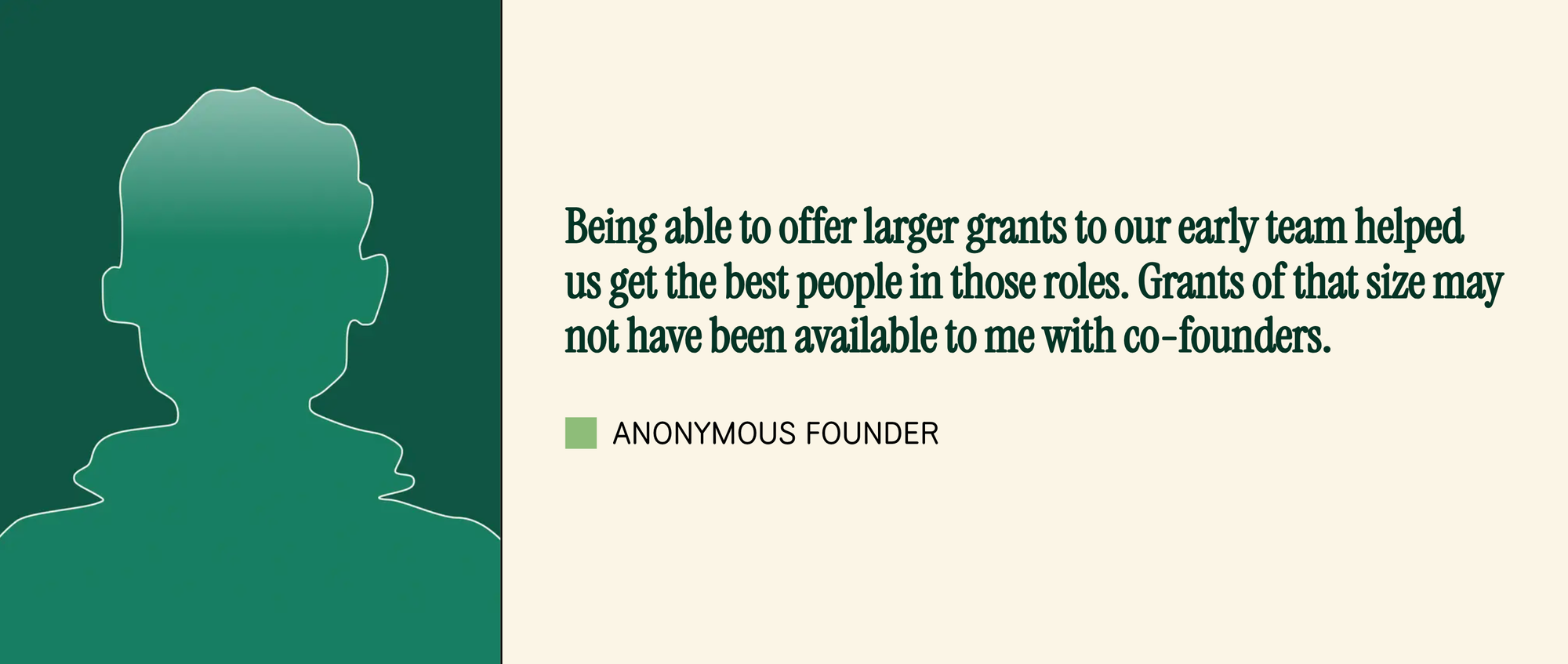
As one anonymous founder told us:
The Transition Moment
These patterns point to a moment of transition in how solo founders build companies. Solo founders are hiring earlier than ever, but they're still operating within frameworks designed for multi-founder teams.
That's changing. As solo founding becomes its own category — not a deviation from the norm but a valid path in its own right — we anticipate that solo founders will increasingly use their extra equity to win the most sought-after talent.
The founders who figure this out first will have a compounding advantage. Better early hires lead to better products, which lead to better fundraising, which leads to the ability to attract even better talent.
The solo founders following market norms on equity grants are leaving their biggest advantage on the table. The ones building category-defining companies? They're not.
This is the third in a series covering the State of Solo Founding report. Read Chapter 1 on The Rise of Solo Founders and Chapter 2 on Fundraising, or download the full report here. Follow along on Twitter for more insights from our conversations with top solo founders.