How Solo Founder Jack Naglieri Built Panther Labs into a Databricks Acquisition

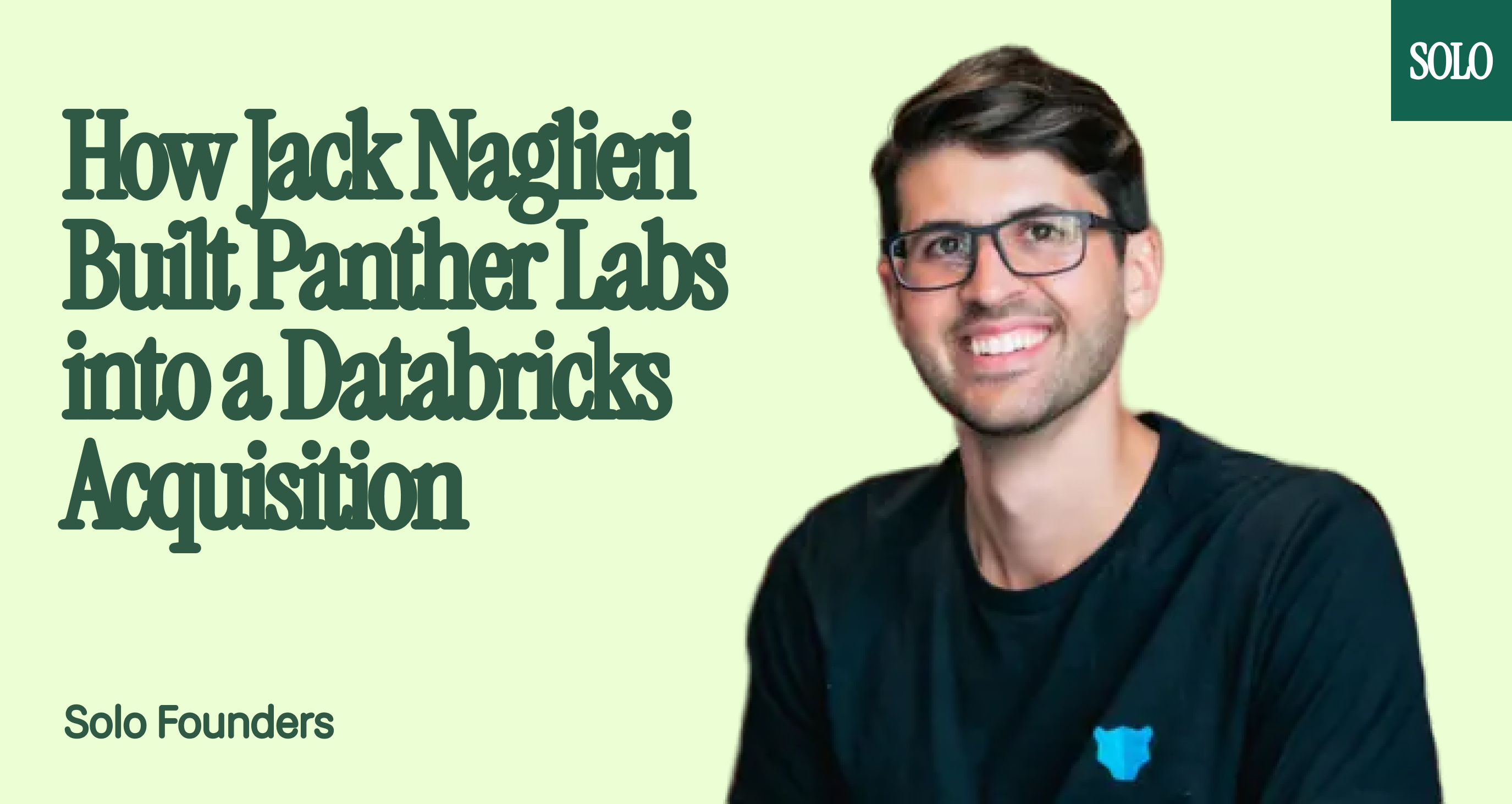
Jack Naglieri solo-founded Panther Labs in 2018 after reaching a conclusion he couldn't shake: security is a data problem.
Over the next eight years, he built the company around that idea. Panther helps security teams detect and investigate threats across modern cloud environments.
He won customers by earning their trust, resisted the temptation to chase every adjacent opportunity, and stayed focused on the same core problem.
This month, Databricks acquired Panther Labs.
This article is part of Solo Founders, a weekly newsletter covering the people, companies, and ideas shaping the rise of solo founders.
The thesis came from the work
Before starting Panther, Jack worked as a security engineer at Yahoo and Airbnb.
At Airbnb, he built an open-source project called StreamAlert to help security teams process and analyze large volumes of cloud data. The project grew out of a frustration he kept encountering firsthand: existing security tools weren't built for the scale and complexity of modern cloud infrastructure.
That experience led him to a broader conclusion: security was fundamentally a data problem. He thinks he was the first to put it that way:
"I always think I'm the first person who said it because as soon as I started saying it publicly, Splunk started copying me."
That belief shaped the company's architecture from the beginning. It wasn't a market opportunity he discovered from the outside. It was a conclusion he reached after grappling with the problem for years.
We've noticed a similar pattern among many solo founders we've interviewed. They don't start by deciding to build a company. They start by developing a strong point of view about a problem and eventually realize they need a company to pursue it.
When we asked Replika founder Eugenia Kuyda why she kept building despite years of skepticism around AI companionship, she gave a simple answer:
"No one believed in it. And I was like, well, I had my faith. I have my conviction. I'm going to continue going."
Conviction gets you started. Trust gets you customers.
Being right about a problem doesn't automatically create a business.
That challenge is especially acute in security, where customers are being asked to trust a young company with some of their most important systems and data.
As Jack has put it, the hardest part isn't the technology:
"Getting your first customer. Security relies heavily on mutual trust, and it's tough to convince someone to rely on you for a critical function early in the journey."
The early years of Panther were about building product and earning credibility.
Jack has talked about sitting with prospective customers, understanding exactly what they needed, and moving quickly enough to show meaningful progress before the next conversation. The goal wasn't to deliver a polished roadmap presentation. It was to solve real problems.
We've heard a similar story from David Phillips, the solo founder of Fondo.
Before selling bookkeeping services, David helped founders file Delaware franchise tax returns for free. He did the work, built relationships, and earned trust before asking anyone to become a customer.
As he told us:
"The best way to build trust is adding value. The best way to add value is to be an expert at whatever you're selling."
Trust isn't built through marketing claims. It's built when customers consistently see evidence that you understand their problems and can help solve them.
Growth created a different challenge
The hardest decisions often arrive after a company starts working.
As Panther grew, there was no shortage of adjacent opportunities. Infrastructure products, new security categories, broader platform ambitions, etc.
Many of them were likely good ideas. People pushed Jack to pursue them. He mostly didn't.
His concern was that every expansion carried a hidden cost. Muddy the offering, and it starts to lose. Customers trusted Panther for a specific job, and every new direction made the company harder to understand and risked weakening that trust.
Michael Grinich, the solo founder of WorkOS, described the same dynamic when we interviewed him:
"You're a restaurant and I'm your bread guy. I bring you bread every night at the same time, because if you're out of bread your guests freak out. But if I start making pizza on the side and selling croissants on Saturday mornings to someone else, people wonder: is my bread going to show up on time or not?"
The problem isn't that the pizza business is bad. The problem is that customers start questioning whether you'll still show up with the bread.
That mindset showed up repeatedly throughout Panther's history. Rather than trying to become everything at once, the company stayed focused on helping security teams detect and investigate threats in cloud environments.
The same philosophy carried into more recent technology shifts. When AI became the industry's default answer to nearly every question, Jack resisted the temptation to ship features simply because customers expected to see them.
"I don't want to ship something that's just to check the box and then it's not helpful. I want it to be valuable."
Sometimes the harder task is deciding what not to do.
The company eventually outgrows the founder
As Panther scaled, Jack had to spend less time being the person doing the work and more time building a team capable of doing it without him. In interviews, he's described the experience as going from the water boy to the coach in a remarkably short period of time.
That meant hiring people who were better than him in the functions they owned.
We've heard the same philosophy from Daniel Francis, the solo founder of Abel Police.
His rule was simple:
"Daniel has to be the worst engineer and the biggest asshole. I'm the floor on engineering talent and the ceiling on being an asshole."
The quote gets a laugh, but it captures something important.
The skills required to start a company are not the same skills required to scale one. Eventually, every founder has to choose between staying at the center of everything or building a team that can operate without them.
Panther's growth depended on the latter.
Eight years of the same bet
Looking back, there isn't a single moment that explains Panther's success.
Instead, Panther was built through a series of decisions that remained surprisingly consistent over time.
The original insight came from years spent working on the problem. Early customers were won through trust. As the company grew, Jack repeatedly chose focus over expansion. And as Panther scaled, he hired people who could take ownership of areas he could no longer run himself.
Together, they built a company valuable enough for Databricks to acquire.
For solo founders, that's probably the most encouraging part of the story. Panther wasn't built by chasing every new opportunity that appeared. It was built by spending years developing a conviction, earning the right to act on it, and staying focused long after there were easier directions to go.
If you'd like more stories like this, subscribe to the Solo Founders newsletter.
Sources
External Reporting and Interviews
- Decibel Capital: Jack Naglieri, Founder & CEO of Panther Labs
- Madrona: Panther Labs, Jack Naglieri, and Modern SIEM Growth
- Software Defined Talk #327 with Jack Naglieri
- Panther Labs: 13 Questions with Founder & CEO Jack Naglieri
- Software Engineering Daily: Panther Security-as-Code with Jack Naglieri
Solo Founders Interviews
- Avoiding The Co-Founder Trap: Eugenia Kuyda on Co-Founder Myths and Why Authorship Matters / YouTube
- 4 Co-Founder Breakups. $40K Left. Then He Went Solo. | David J. Phillips, Fondo / YouTube
- The Co-Founder "Blood Bond" Is a Myth | Michael Grinich, WorkOS / YouTube
- Don't Be Greedy With Equity: Daniel Francis on Solo Founding and Building for Police / YouTube