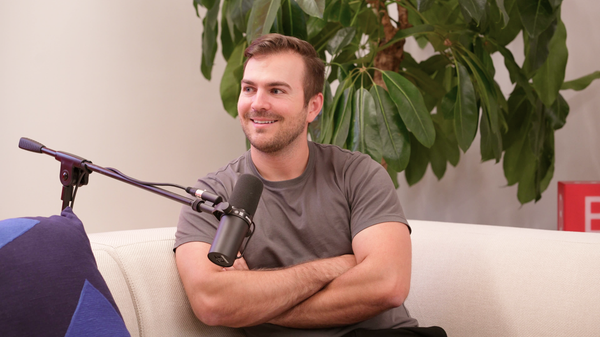
Don't Be Greedy With Equity: Daniel Francis on Solo Founding and Building for Police
Solo Founders Podcast — Episode 5 with Daniel Francis

Key Takeaways
- Daniel completed 39 police ride-alongs to deeply understand policing — and requires every Abel employee to do one too
- Solo founders should give more equity to early hires, not less. Hoarding equity as a solo founder is penny wise and pound foolish
- The emotional reality of solo founding includes crying alone in the middle of the day — but Daniel never once considered giving up
- Officers spend one-third of their shift writing reports. Abel Police uses AI to generate police reports from body cam footage, giving that time back to patrol
- Every 115 officers on the Abel platform translates to one life saved per year, based on studies linking marginal officer availability to homicide rates
Listen: YouTube | Spotify | Apple Podcasts
Introduction
Daniel Francis has had an unusual rise. To catch you up to speed: he dropped out of high school, taught himself to code at a DC nonprofit, impersonated a laid-off Twitter employee, got hired by Elon Musk, and then got fired by Elon Musk (who called to apologize). He built a fitness app to $30K MRR and sold it. Then he walked away from mercenary startups entirely and built Abel Police — AI software that writes police reports from body cam footage, saving officers a third of their shift from paperwork.
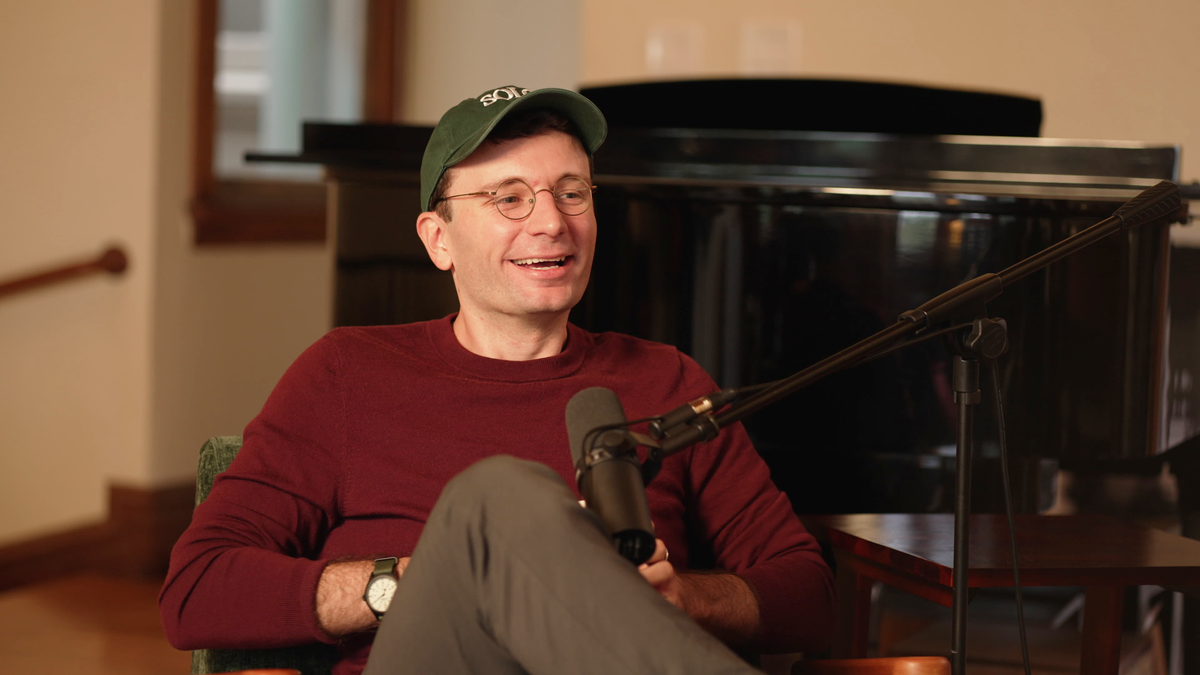
This is one of the most intense and personal episodes of the Solo Founders Podcast so far. In this conversation with Julian, Daniel shared the harrowing personal experience that led him to policing, why he believes solo founders have a massive authorship advantage, and his unfiltered take on co-founders, company culture, and the raw emotional toll of building alone. He named his company after Abel — the first victim of a crime in the Bible — and has completed 39 police ride-alongs to understand a world he'd never lived in.
The Domestic Violence Story That Started Everything
Daniel's path to police-tech began with a phone call. A friend he hadn't spoken to in years reached out. She'd married a man who had started abusing her, and she needed help getting out. Daniel helped her get an apartment, a domestic violence restraining order, and the legal protections the law affords.
Then the courthouse made a mistake — they sent the paperwork with her address to her husband. He showed up, banging on the door, threatening to kill her. It took police 45 minutes to arrive.
"The restraining order doesn't have a gun."
When Daniel approached the officer to complain about the response time, something unexpected happened. The officer didn't get defensive. He slumped and apologized: the agency was short-staffed, there'd been a shooting that morning, everyone was on overtime. Daniel's frustration instantly turned into a question: what can I build for these guys?
That question led him to the "PDF mines": staffing analyses that agencies commission from consultants. SFPD's 2021 staffing analysis revealed the insight that became Abel's foundation: officers spend one-third of their time writing reports. If you wear a body cam on your chest, that's an absurd amount of time filling out forms.
From Mercenary to Missionary
Before Abel, Daniel was building a fitness app that hit $30K MRR. It was a mercenary play — a way to make money. But after his experience with the police and a stint working at Twitter under Elon Musk, something shifted.
Daniel had impersonated a laid-off Twitter employee to get hired. Working under Elon, he watched people get fired without hesitation and asked Elon if he felt weird about it. Elon's response was simple: they're in the way, they have to go. That clarity of alignment stuck with Daniel.
"You can use words to write a machine that prints money. That's crazy."
The fitness app printed money. But Daniel realized he needed the stakes to be real. Abel's math gives him that: every 115 officers on the platform translates to one life saved per year. If an engineer makes the software 10% worse and someone dies as a result, Daniel can fire that person without internal conflict. That's the kind of alignment Elon taught him — and the kind he needed to feel about his own company.
Anti-Culture Culture
Daniel doesn't believe in company culture. He believes in deadlines, tickets, and standards.
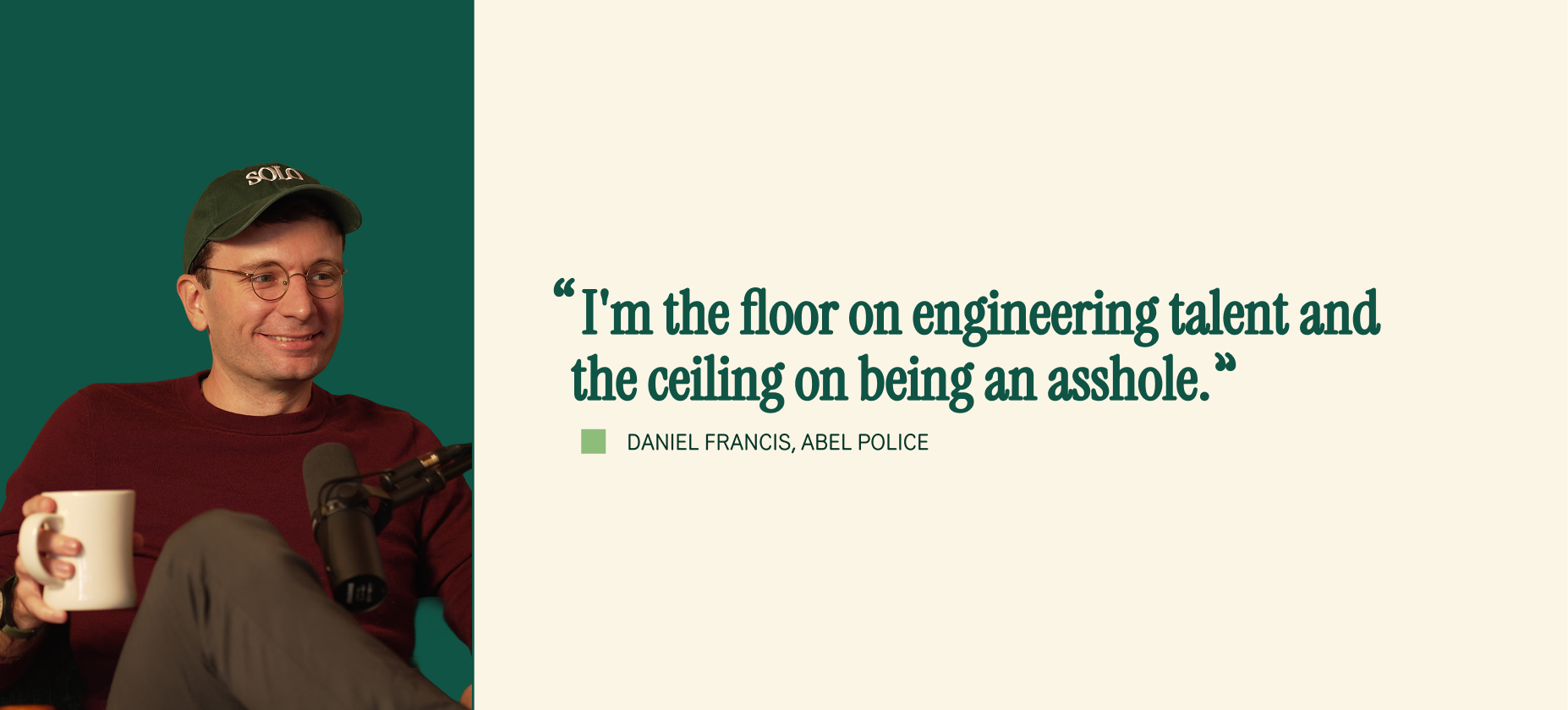
Abel has a document called "Working at Abel." The first bullet point: Daniel has to be the worst engineer and the biggest asshole on the team. He's the floor on engineering talent and the ceiling on being difficult to work with. Anyone who violates either of those standards has to go.
The culture, as Daniel describes it, is simple: hurry up, here's the tickets, move. We got to get this done and it needs to be better. No pleasantries. No cupcake-making events. Sometimes conversations about Lana Del Rey. But mostly — is your ticket done?
This sounds brutal, but Daniel argues it's actually a compliment to engineers. Holding people to a high standard and firing underperformers means the people who stay never have to work with idiots. Mission-critical software demands this intensity. And every Abel employee has been on a police ride-along. They've seen what the stakes look like from the passenger seat of a patrol car.
39 Ride-Alongs and the Boy Scout Hustle
Getting into the space wasn't easy. Daniel started with SFPD and made it all the way to the CIO — but the red tape at a large agency was overwhelming. So his girlfriend helped him make flyers, and he went around the East Bay "like a little Boy Scout," handing them out to police agencies.
Most agencies thought his idea was unreasonable. A random tech guy wanting to use AI to write their sacred police reports? They asked him if it was illegal.
Then he found Richmond PD. He demoed using fake body cam footage he'd made by holding his phone to his chest and warning friends for littering. The admin captain watched the demo, stared at the screen, and said: "That's bitching. You have got to do that here."
Richmond was understaffed and suffering. That suffering made them the perfect early adopter — exactly the kind of customer startup playbooks say to find first. From that one embedded relationship, Daniel has now completed 39 ride-alongs, and the depth of understanding they've produced is irreplaceable.
The Solo Founder Equity Mistake
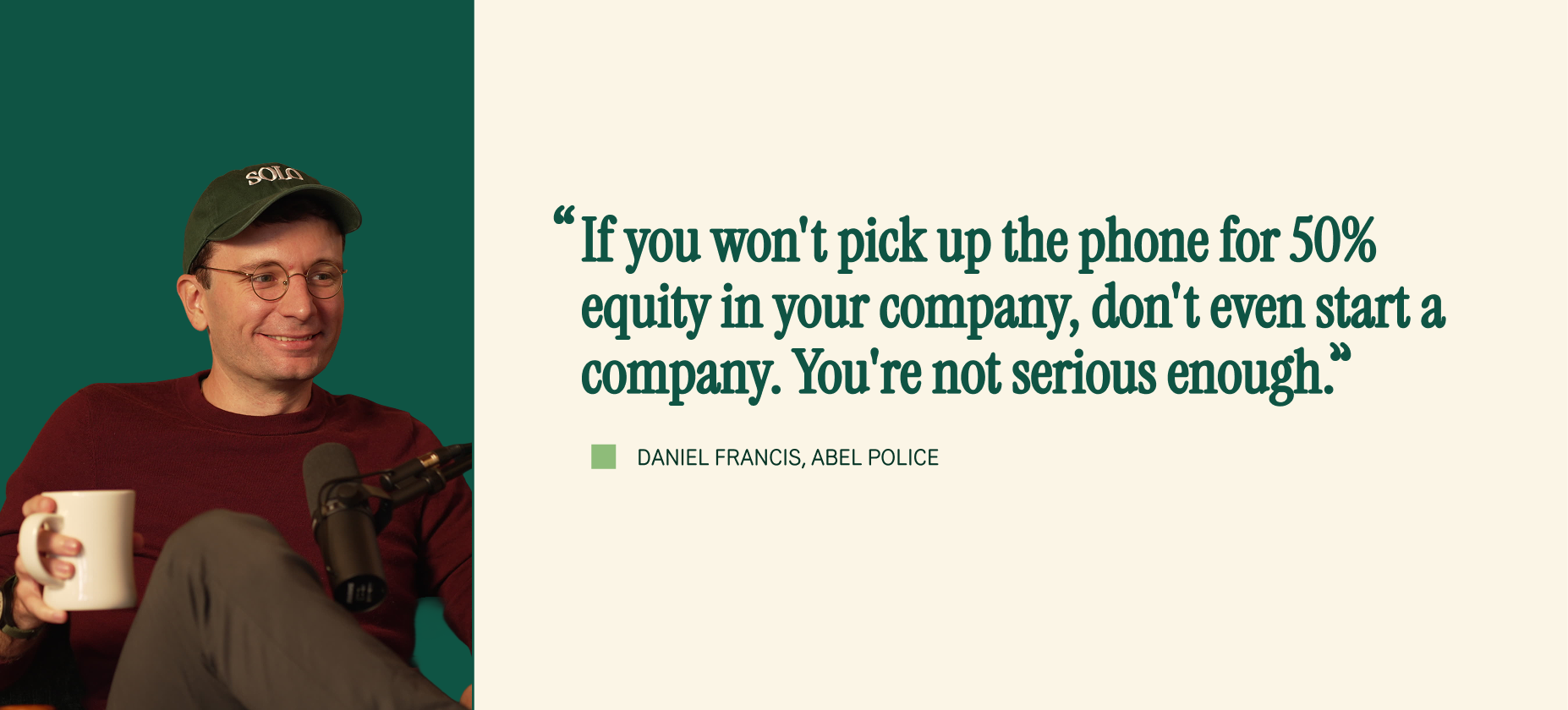
During the Carta data commentary section of the episode, Daniel reacted to a finding that surprised him: solo founders give comparable equity to early employees as multi-founder teams. His reaction was blunt — solo founders in this data are being too greedy.
Daniel argues solo founders should be giving significantly more equity to early hires. They have the ownership to spare, and generous grants transform employees into co-owners. His CTO was someone who could have started his own company but chose Abel because the equity made him feel like a partner, not an employee.
"Solo founders in this data are being too greedy."
The counterbalance: a six-year vesting schedule. Give more, but require longer commitment. The result is early hires who are as invested in the outcome as a co-founder would be — but you can fire them if it doesn't work out.
Bear Case, Bull Case
Daniel gave both sides with the kind of bluntness you'd expect from someone who fires people for writing bad code.
The bear case: if you're an engineer with no design sense, no sales instinct, and no ability to write, you need a co-founder. Some people simply lack the range to do everything a founder has to do in the first year. If you can't sell, you can't start. And the loneliness is worse than anyone warns you about.
The bull case: solo authorship. Daniel compared it to Apple versus Google — one company builds coherent, opinionated products because one person's taste runs through everything. The other builds by committee and it shows. A solo founder is the sole author. The product, the culture, the hiring bar, the company's reason for existing all trace back to one brain.
And then there's the practical advantage no one talks about: you can fire your way to a better team. A co-founder with 50% equity and a board seat is nearly impossible to remove. An employee with generous equity and a clear performance bar is not. Daniel's structure gives him the alignment of co-ownership with the flexibility of employment.
His closing advice: if the loneliness is the problem, buy a puppy.
The Emotional Reality
Julian asked Daniel what question he should have asked. Daniel's answer was about crying.
The middle of the day, some piece of news hits, you haven't been sleeping, your life is a roller coaster and there's no one there with you. Maybe this is stupid, maybe you're an idiot and you're just randomly crying in the middle of the day.
Daniel had months of that. Walking to the office at eight, walking home at eleven. Half the day spent on ride-alongs, no co-founder to share the weight.
"I'm on this raft — if it turns out we are headed towards Niagara Falls, I guess I'm gonna die."
But he never considered giving up. Not once. The idea of throwing in the towel simply never occurred to him. For Daniel, the only way off the raft is through.
About Daniel Francis
Daniel Francis is the solo founder and CEO of Abel Police, an AI-powered platform that generates police reports from body cam footage. Before Abel, Daniel was an economics and math major at Florida State University who taught himself to code at the Mercatus Center in DC, built a fitness app to $30K MRR, and briefly worked at Twitter under Elon Musk. A devout Catholic convert, Daniel named his company after Abel — the first victim of a crime in the Bible — and has completed 39 police ride-alongs to deeply understand the world he's building for.
Subscribe to the Solo Founders Podcast on YouTube, Apple Podcasts, or Spotify.
Join our newsletter for weekly insights from solo founders.