65% of Startups Die From Co-Founder Conflict. Julian Weisser on the Six Questions People Actually Ask About Going Solo

Key Takeaways
- The co-founder default has a body count. Roughly 65% of high-potential startups that fail die from co-founder conflict. "It's not about product or about customers — it's about people. And when you're starting a company, the only people are the co-founders."
- Solo founders swap that failure mode for a different one. "The biggest reason companies blow up in the early days is no longer applicable to solo founders." The real risk is isolation — and it's manageable in a way a bad co-founder isn't.
- "We don't invest in solo founders" is usually the polite reason. "It's a lot easier than saying 'I don't really believe in you.'" Take the pass seriously; don't over-weight the stated reason.
- Investors read your judgment through your hires. Bring on three teammates and "75% of the people are now not the founder" — and being less dilution-sensitive lets you choose the better firm over the better valuation.
- The denominator delusion. Most great companies had co-founders. So did a far larger pile of failures nobody counts. "You have the opportunity to be one of the winners."
Listen: Apple Podcasts | Spotify
Introduction
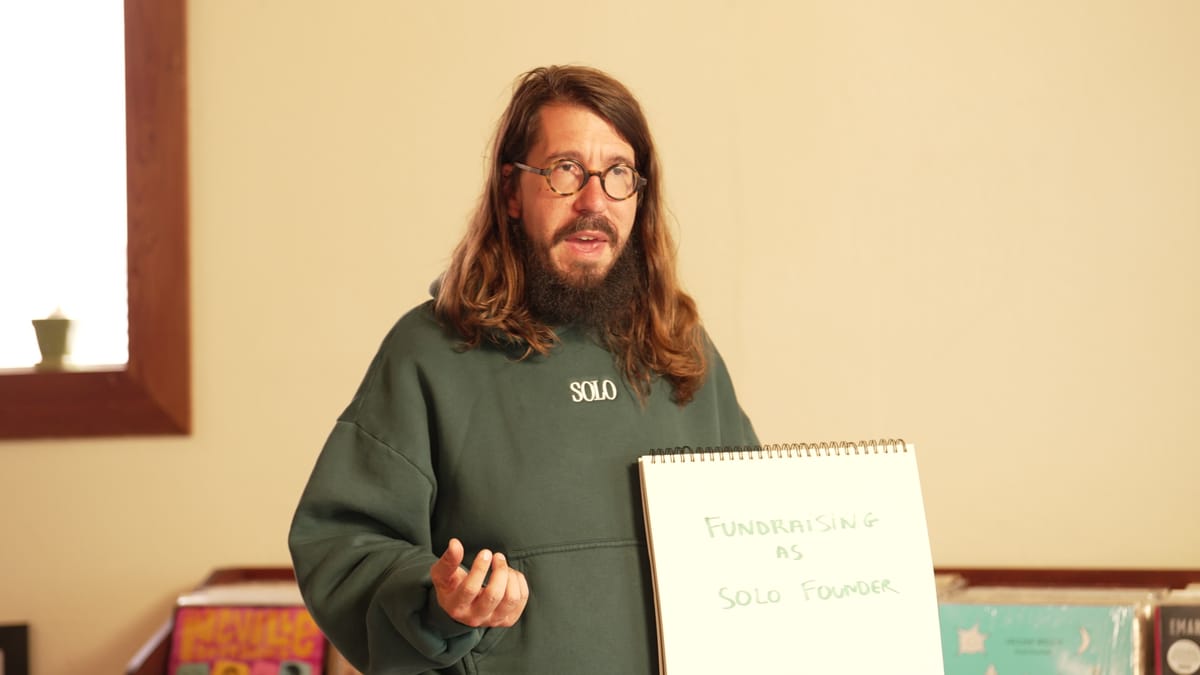
"Should I find a co-founder?" is asked in every accelerator office hours, every founder Slack, and — it turns out — in the search bar more than any other question about starting alone. Julian Weisser has been on both sides of it: seven years at ODF helping people find co-founders, then Solo Founders, built on the premise that the next decade's best companies will increasingly be started by one person. For this episode he worked through the six questions people ask most about going solo — do you need a co-founder, is it as lonely as it sounds, who has actually done it, how do you raise alone, do solo founders fail more, and what is "solo founder syndrome" — cold, one at a time, in twenty minutes.
The answers are not a pep talk. They are a piece of arithmetic he keeps returning to: about 65% of high-potential startups that fail die from conflict among their co-founders. (The figure is Noam Wasserman's, from Harvard Business School research on roughly ten thousand founders.) "It's not about product or about customers — it's about people," Julian says. "And when you're starting a company, the only people are the co-founders." Everything else in the episode follows from taking that number seriously.
The Failure Math
Julian's answer to the first question is not "don't get a co-founder." It's that the bar for one should be far higher than the industry treats it. "We still think the value of an incredible co-founder is extremely high. Having said that, the bar for what makes an incredible co-founder should be very, very high. You should not end up with a co-founder of convenience just because you think other people think you should have a co-founder."
The reason is the 65%. A co-founded company carries the most common cause of startup death inside its founding team from day one. A solo company doesn't. "Solo founders — how do they fail? Well, they don't have co-founders. So the biggest reason companies blow up and fail in the early days is no longer applicable to solo founders."
"We're not saying don't have a co-founder. We're saying don't let a co-founder be the thing that impedes you from getting started and building a great company."
That is the brand's position in one sentence — permissive, not prescriptive. The data is at least pointed his way: solo founders now start over one-third of new companies, up 53% since 2019, per Solo Founders' State of Solo Founding report.
The Solo Failure Mode Is Loneliness, Not Competence
If co-founded companies die of conflict, what do solo companies die of? Julian's answer is unusually direct for someone in the business of encouraging people to start alone. "The main failure point for solo founders is pretty simple: it is extremely lonely when you're building on your own." No one with equal weight in the outcome, no one to fall back on when the idea isn't working — "you don't have a co-founder to cause the company to implode, so instead, the biggest risk is that you actually die." One founder in the Solo Founders program described the early stretch to him as "zero to one is hell if you're a solo founder."
The fix is not to find a co-founder after all. It is to stop building alone. "You shouldn't be building alone as a solo founder — but you shouldn't necessarily be trying to find a co-founder either. You should be building solo, together." Proximity to people who have context on your business, no forced pairing — the model the Solo Founders program runs on, and something any founder can arrange for themselves. The rest is almost domestic — sleep, don't disappear into product when you should be talking to customers — which is the point. The solo failure mode is a hygiene problem. The co-founded one is structural.
The Easy Out
The fundraising question is where the episode gets most tactical. Founders raising alone routinely hear "we don't invest in solo founders," and Julian's read is that most of the time it isn't the real reason.
"'Oh gee, I'd really love to invest in you, but I don't invest in solo founders' is a lot easier than saying 'I don't really believe in you, or your company, or your market.'"
Investors who pass avoid saying what they actually think, because it's personal. So: take the pass seriously — "they usually don't" change their mind — and don't over-weight the stated reason, which was chosen to preserve the relationship, not to inform you.
What a solo founder should expect instead is a harder line of questioning about hiring. A co-founder is an easy barometer of a founder's talent bar; without one, investors infer it from who you intend to hire next. "Remember, you are one person. If you bring on three teammates, 75% of the people are now not the founder." The hiring thesis is part of the pitch.
And there is an advantage most solo founders don't price in. A three-way split makes every point of dilution hurt three times over, which tempts co-founded teams toward the higher valuation from the weaker firm. "As a solo founder, you don't have to optimize exclusively for valuation the way you might be tempted to if you're already splitting the company multiple ways with co-founders." The report agrees: solo founders kept 75% more ownership at exit.
The Denominator Delusion
The third question — who has actually done this — gets a short answer because the list is long: Pierre Omidyar started eBay as a one-person sole proprietorship, Michael Dell started Dell from a dorm room, Eric Yuan founded Zoom; today, Paul Klein IV at Browserbase, Michael Grinich at WorkOS, Celine Halioua at Loyal, and Ben Cera at Polsia, who is attempting what Julian calls True Solo — no human teammates at all. The fifth question, solo founder success rate, gets the episode's cleanest reasoning. Julian starts with a concession — "the data has not shown anything definitive in the negative against solo founders" — and then names the mechanism behind the bias anyway.
"The bias people have against solo founders is they believe most of the best companies are started with co-founders. And if you think about it, they're right. But there's something really important missing from that, which is the denominator. How many of the companies that have failed also have co-founders?"
Count only the winners and co-founding looks like the winning strategy. Count the whole distribution and the picture changes: many great companies were co-founded, "and many, many, many more are started that ultimately fail." The denominator, in his phrase, "is devastating for co-founded companies." He first laid this out as a guest on episode 8; this is the ninety-second version worth sending to anyone who cites the winners without the base rate.
The Case for Going Solo (and a Word on "Syndrome")
Julian's closing argument lands on the numbers. "Realize that yes, you have another reason your company can die that's different from co-founded companies — but also realize that the numerator and the denominator are much smaller for solo-founded companies. You have the opportunity to be one of the winners. You just need to keep going."
The sixth question, "solo founder syndrome," he had never encountered, and his first reaction on tape is not fit for print. Once he'd read the card — it seems to mean doesn't play well with others — the rebuttal was quick: "I would like to ask the 65% of companies that fail what kind of syndrome they have with their co-founders." The diagnostic is self-cancelling: "No jerk actually worries about being considered a jerk. So the only people who need to worry about solo founder syndrome are the people who would never let it cross their mind."
About Julian Weisser
Julian Weisser is the founder of Solo Founders, a community, media brand, and $100K-per-founder program for people starting companies without a co-founder. He previously co-founded On Deck (ODF), where he spent seven years running the largest co-founder-matching program in tech — the experience that produced both his respect for great co-founders and his conviction that the co-founder default is broken. He hosts the Solo Founders Podcast and coined the "denominator delusion." The State of Solo Founding report he references is at solofounders.com/report.
Subscribe to the Solo Founders Podcast on YouTube, Apple Podcasts, or Spotify.
Join our newsletter for weekly insights from solo founders: solofounders.beehiiv.com
Building solo? Applications for the next Solo Founders cohort are open: solofounders.com/program