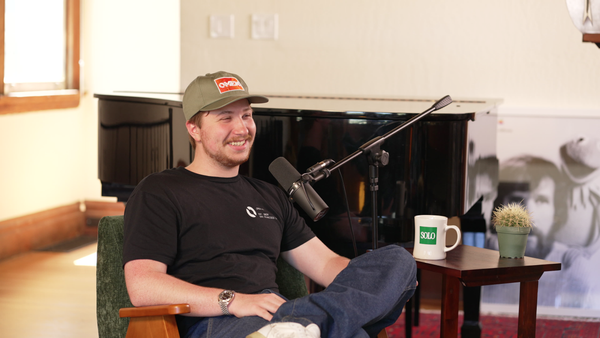
His Public Company Blew Up. He Came Back Solo.

Key Takeaways
- He's not anti-co-founder — his were great. Francis built Sonder into a multi-billion-dollar company with co-founders he loved. He went solo this time because the cost of a wrong co-founder is now fatal, and the opportunity won't wait a year.
- Skip the MVP. Coding agents compressed his idea-to-launch timeline by roughly 30x. The MVP was a workaround for scarce resources — agents remove the scarcity, so build the ambitious version from day one.
- Solo isn't alone. Francis is a solo founder with a seven-person founding team — everyone titled "founding," with true end-to-end ownership.
- The one-person billion-dollar company is a myth. Even building with AI every day, he's skeptical: taste, design, naming, and judgment still need people.
- Founder mode beats delegating to executives — the hardest lesson from scaling, and losing, Sonder.
Listen: YouTube | Apple Podcasts | Spotify
Introduction
Most founders only ever see one side of the story. Francis Davidson has seen both — the billion-dollar climb and the public collapse — and he started over the same month he lost the first company.
At 19, he began subletting Montreal students' summer apartments. That side hustle became Sonder: a hospitality company that grew to roughly $100M in revenue, around 1,000 employees, and roughly a $2B valuation when it went public. Then Covid arrived. City hospitality revenue fell about 90% — worse than the Great Depression — every venture-backed competitor died, and after taking the company public too early, Francis was pushed out as CEO. Months later, Sonder collapsed.
The month he left, he incorporated his next company. This time he's solo, building Odessia — an AI travel agent that plans and books an entire trip in a single conversation — with a seven-person founding team and a non-technical founder shipping much of the product himself. The conversation with Julian Weisser is the honest version of the comeback: why he went solo when his co-founders were great, why he skipped the MVP, and what building (and losing) a billion-dollar company teaches you about doing it again with almost no one.
The Rise and Fall of Sonder
Francis incorporated the business at 19 with no capital, no network, and no real plan beyond a simple arbitrage: take students' apartments while they were away for the summer, rent them to travelers, keep the spread. A million dollars in first-year sales told him there was a real company in it. He studied hospitality and saw a chance to build a brand travelers trusted — not "Joe's place," but a name, the way Hilton or Hyatt had. Building a company, he says, is the closest thing he'll come to making artwork.
That artwork scaled fast, then met catastrophic timing. Sonder had signed long real-estate leases to run apartments like hotels — exactly the wrong position when travel evaporated. Francis raised around $400M to survive, took the company public before it was ready, and spent years untangling the mess. A 20-year Marriott partnership was the high note. It was also the exit cue: with the stock down 99% and the board's confidence gone, they forced him out. Four months later, the company he believed he'd left in good shape unraveled completely.
What he did next says the most about him: nothing dramatic. He started again immediately. "This is who I am. It's what I've been doing forever, and I love it."
He Loved His Co-Founders. He Went Solo Anyway.
Here's the detail that makes Francis a credible voice on solo founding: his first-time co-founders were excellent. One started as director of finance and was promoted to co-founder years into the journey. "It's fine to be a little fluid with the titles," he says. So going solo this time isn't a grudge. It's a calculation.
"Going solo wasn't a strict philosophical decision — it's happening because we just have to get going."
The math has shifted. The downside of a wrong co-founder is now severe enough to kill a company, and the upside of holding out for a perfect one rarely justifies the months it costs. Francis can't spend six, twelve, or eighteen months on co-founder dating while the opportunity sits in front of him. As Julian framed it, founders are going solo "not because they're anti-co-founder — the consequence of a bad co-founder decision is so high it can destroy the company." Francis lived the good version and still chose solo. That's the strongest endorsement of the path there is: not from someone who never had the option, but from someone who did.
Five Months, No MVP
Francis is a non-technical founder who now ships a meaningful share of his own product. Odessia's codebase started in January and launched in preview by early June — five months, end to end, for an ambitious product.
"Coding agents are rewriting the playbook for startups. You used to need an MVP because resources were finite. Now you should build something much more ambitious."
The team is built to match: small, senior, parallelized — people own discrete product areas, track everything in Linear, and run independently. He screens for the mindset in interviews ("what's your setup to use coding agents really well?"); the sweet spot is someone "mind-blown at how good the tools are, but also aware of their limitations." The skeptics who insist on doing every keystroke themselves don't make the cut.
"I'm Skeptical of the One-Person Billion-Dollar Company"
For all the AI-speed evangelism, Francis is refreshingly skeptical of the hype — and he's earned the standing to be.
"I'm very far from thinking you can build these companies autonomously — which is why I'm skeptical of the one-person billion-dollar company."
He frames it through Moravec's paradox: the models do PhD-level math but can't reliably tell when a button is duplicated and the front end is broken. Back-end engineering is phenomenal; prompt engineering, naming, design, and taste are "total garbage." He tried to use the models to name the company and gave up — six weeks, by hand, for each brand name. (There's a Greek god of travel, Hermes, but no goddess — so he made one up.) Solo, for Francis, means small — not alone, and definitely not automated.
The Case For — and Against — Going Solo
Asked for the bear case, Francis concedes only one real argument: speed. Could world-class co-founders grinding alongside him go faster? Maybe — but often the opposite is true. As he puts it, there's usually one general on the battlefield; with two, three, or four, things get out of hand.
The bull case is where he's spent the real thought. You don't need the whole bench up front; the best people are easier to attract after you've built something and put it in the market. He has no CTO right now — a great chief product officer and strong founding engineers are plenty for now, and the CTO he can hire a year from now will be far better than anyone he could land today. And the search itself is expensive.
"Co-founder dating is expensive. I went down that path and thought: the entire 40 hours are gone, and I'm back to square one."
With coding agents multiplying what one person can ship, every hour not spent building or talking to users carries an enormous opportunity cost. That's the quiet engine under the whole decision.
The Lesson That Survived Sonder
When Julian asks what was inside his control at Sonder that he'd do differently, Francis doesn't hesitate. The standard advice — hire exceptional executives, delegate, get out of the way — failed him most of the time.
"Don't hire people who just manage people — hire the best practitioners. No one wants to work for someone who can't teach the craft."
He's grown skeptical of professional executives who are "further from the building and really good at getting promoted." The model now: everyone carries an individual-contributor workload, management happens on the side, and you grow leaders from your best builders instead of importing them. With agents multiplying personal output, that bias toward makers over managers only sharpens.
About Francis Davidson
Francis Davidson is the founder and CEO of Odessia, an AI travel agent that lets you plan and book an entire multi-stop trip in a single conversation. He previously founded Sonder, the hospitality company he started at 19 and grew into a billion-dollar business with 1,000+ employees before taking it public. After Covid devastated the sector and he was pushed out as CEO, Davidson launched Odessia solo in 2026 — a Sequoia-backed, eight-person team building in preview, with the founder himself shipping product alongside AI coding agents.
Subscribe to the Solo Founders Podcast on YouTube, Apple Podcasts, or Spotify.
Join our newsletter for weekly insights from solo founders: solofounders.beehiiv.com