She Raised $18.5M Solo to Kill AI Slop

Key Takeaways
- Taste isn't personalization — it's a measurable bar for quality. Personalization is one person's preference. Taste is the expert-validated judgment of what "great" looks like in a domain with no single right answer.
- AI slop is a volume problem, not a "bad model" problem. Millions of people use the same tool for totally different purposes and get the same output. A quirk on one person is a signature; the same quirk on a hundred million is slop.
- She went solo because a co-founder felt forced. Thais considered one, decided it was happening because she felt she had to, and just started instead. ("I didn't want to not start just because I hadn't found this perfect magical co-founder.")
- You're probably bad at commissioning AI. Being a good "commissioner" — uncovering and expressing intent — is its own skill. Half the gap between you and a good result is on your side of the prompt.
- Don't average everyone's taste — it collapses. The goal is a model that knows what great looks like for both maximalism and minimalism, without ruling which is better.
Listen: YouTube | Apple Podcasts | Spotify
Introduction
Everything AI makes is starting to look the same. The same em-dashes. The same purple gradients. The same competent, faintly soulless output that's earned its own name: slop.
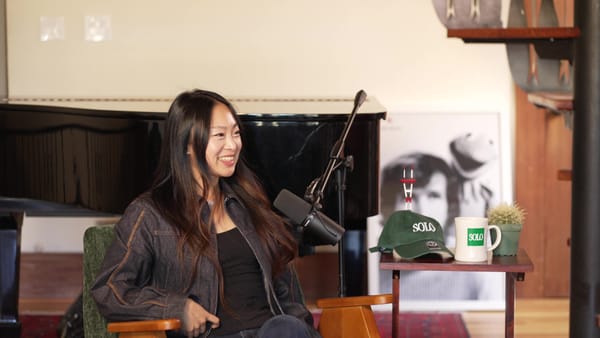
Thais Castello Branco left the AI search company Exa, raised $18.5M, and built Taste Labs — the "taste layer for AI" — to fix exactly that. The mission, stated plainly, is to end AI slop: to give models and agents the thing that makes output feel genuinely good rather than generically passable. And she did it as a solo founder.
Her conversation with Julian Weisser is one of the most genuinely philosophical the show has run — what taste actually is, why AI sameness is dangerous, how you turn something as subjective as "great design" into data a model can learn — wrapped around a quietly compelling case for going solo. Here's the through-line.
What "Taste" Actually Means
Most people, Thais argues, conflate two different things.
"People conflate taste and personalization. Personalization is one individual's personal preference. But taste is almost more this measurement of quality — in a domain where there's not a single correct answer, how do you define what great looks like?"
That distinction is the whole company. Personalization is about you. Taste is a shared, expert-validated bar for quality — not everyone has to agree, but the people who've put in the reps tend to. It's a skill built over years of exposure, pattern recognition, and down-selection, which is exactly why it's rare. And it's the thing today's models, for all their intelligence, mostly don't have.
Why Everything AI Makes Looks the Same
The most clarifying idea in the episode is that slop isn't a sign the models are "wrong." It's a side effect of scale.
"Suddenly you have millions of people creating with the same tool for totally different use cases — but the output looks the same. That's where the feeling of slop comes from. It's the volume."
A quirk on a single human reads as a signature — the thing that makes their work theirs. The same quirk applied across hundreds of millions of people, for completely different purposes, reads as thoughtless. Thais is deliberate about her vocabulary here, too: she won't say AI lets people create. She says it lets them generate.
The fix isn't randomness. You could crank a model's temperature and get more variety, but variety without intent is just noise. What's needed is diversity plus fit — output that feels purpose-built for the specific situation. And the stakes, she thinks, are real:
"We're going to get used to slop and start thinking it's normal — as a society. And I don't want that to happen. I want people to be very aware that that's a low bar."
Turning Something Subjective Into Something a Model Can Learn
If "great design" is impossible to define in one sentence, how do you train a model on it? You break it down. Some layers are nearly objective — instruction-following, contrast, typography, white space — and you fix those first. Higher up, you reach style, creativity, and personalization, where experts genuinely disagree. Crucially, Thais treats that disagreement as the point, not a problem to engineer away. If you just average everyone's taste, she says, it collapses — far better to teach a model what great looks like for both maximalism and minimalism, without ruling which one wins.
That's also why it's a lab. As she puts it, enormous research effort goes into making models great at coding — and almost none into making them write well, understand nuance, or have anything like emotional intelligence. Taste Labs works with a community of around 800 vetted "tastemakers," deliberately diverse, to build the rubrics and data that capture that range instead of flattening it.
You're Not Bad at AI. You're Bad at Commissioning It.
One of the most useful threads for anyone who uses AI tools: a big chunk of the quality gap is on the human side. Julian framed it as a skill we don't talk about.
"People are bad at commissioning things — which is just another way of saying bad at prompting things. It's its own skill."
Thais agreed it cuts both ways. "Make it pop" means nothing without intent — it could mean chunky fonts and saturated colors, or a soft pink vibe. The best designers she's met are the ones who take a vague brief and ask the right questions to uncover what the client actually wants. The future, she thinks, is a spectrum: some products will let you one-shot a great result from a simple prompt; others will run an iterative, optician's-lens loop — this one or that one? — to refine your intent with you.
The Case for Going Solo
The episode ends on the show's two customary questions, and this is where the Solo Founders thesis lands. Thais didn't go solo on principle. She considered a co-founder — and it felt forced.
"I considered having a co-founder. But then it felt forced. I felt like I was doing it because I felt like I had to. So I just kept going, kept going. And it ended up working."
It's a stance Julian's "denominator delusion" sharpens: we celebrate the co-founder success stories and quietly ignore that most dead companies die of co-founder conflict. (Thais's own husband is also a solo founder; they're complementary enough that people keep asking why they don't build together — and self-aware enough not to.)
She's honest about the cost. The bear case: "You should only be a solo founder if you have incredibly high pain tolerance" — every day is a battle, and it's lonelier, because giving someone the full context is expensive. The bull case is conviction: she knows exactly how "150% in it" she is, and that gives her a deep trust in herself to see it through.
About Thais Castello Branco
Thais Castello Branco is the founder and CEO of Taste Labs, the "taste layer for AI" — a data and infrastructure company building the preference datasets, rubrics, and evaluation tools that teach AI models and agents to recognize quality in subjective domains like design and writing. Its mission is to end "AI slop." Before Taste Labs she worked in consumer-goods new-product development in New York, started an earlier company in Brazil, and was on the early/growth team at the AI search company Exa, where she got a close-up view of where models fall short. She left to solve the taste problem and raised an $18.5M seed (co-led by CRV and Amplify Partners) to do it — solo.
Subscribe to the Solo Founders Podcast on YouTube, Apple Podcasts, or Spotify.
Join our newsletter for weekly insights from solo founders: https://solofounders.beehiiv.com/