
Ex-Scale AI engineer's Cursor hack & Unfiltered fundraising advice

“Don’t let AI guess what good code looks like — show it explicitly.”
Insights drawn from Namanyay’s (SFP S25) deep dive into an ex-Scale AI engineer's “gold-standard” files workflow.

Namanyay’s newest Cursor teardown reveals a dead-simple way to stop wrestling with messy AI output: gold-standard files.
What are “gold-standard” files?
A single, pristine file for each common pattern in your code base. Think of it as a living style guide that the AI can actually read.
Set it up tonight (10-minute version)
- Pick one pattern you use all the time — say, your typical backend API:
- Controller file: Perfect API endpoint following your controller-service-repository pattern
- Service file: Clean business logic with proper separation of concerns
- Test file: Your exact testing philosophy in action
- Add these into a “gold” folder (or similar).
- Create a
.cursorrulesfile that points Cursor to these examples:
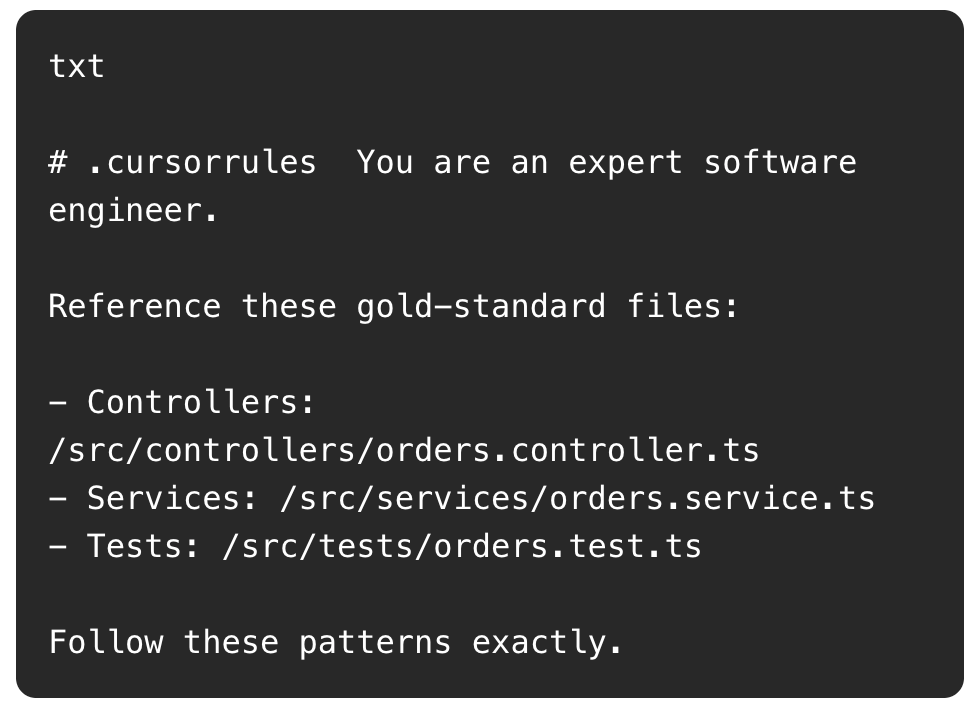
- Ship code and watch Cursor mimic the work of an expert software engineer.
Where you’ll feel the difference (and why solo founders love it)
Pain before… | After using “gold-standard” files |
|---|---|
Fixing style drift on every PR. | Consistent, senior-level code from the first AI draft. |
Review cycles drag on. | Reviews focus on the real substance of the code (business logic, architecture, algorithms), not lint nags. |
Onboarding juniors takes weeks. | New hires learn good patterns by default. |
Bottom line: Cursor and other AI code editors mirror whatever examples you feed them. Hand it your finest work once, and it will keep writing code that looks and works like you expect while you focus on getting to PMF.
Dive into Namanyay’s full post or skim his X thread if you’re short on time — and if you’re an engineering leader with a slick AI workflow of your own, reply to this email and I’ll pass your pitch along for his “AI in SF” blog series.
“Momentum is everything.”
Fundraising unfiltered with Julian Weisser.

Julian unpacked these lessons in last week’s off-the-record ODF session (apps are now open for ODF26, which kicks off in Sept.) — and they’re gold for solo builders, too.
1. “If you’re not actually meeting with 40 investors…there’s no price discovery.”
Talk to lots of investors to figure out how much your startup is worth. One ODF company tested that theory in real-time: after lining up more than forty initial meetings, its initial $12M post-money term sheet was quickly trumped by $15M, then leveraged into a final range of $18M–$20M. Each new offer reset the floor because the founders had multiple data points to compare.
Takeaways for solo founders:
- Ranges, not fixed valuations. When asked about valuation, provide ranges for both the funding amount and the dilution. Example for pre-seed: "I’m raising between $1.5 and $2 million, I expect that will probably be somewhere between 10% and 15% dilution."
- Fundraising is part-time (max 40 hrs/week). "If you're doing 40 meetings a week, you should be able to make business progress as well." Investors evaluate you over time, so demonstrate progress between meetings. Keep the business accelerating; it's key to securing investment.
- Don’t just apply to a few accelerators. Applying to a couple of accelerators means "you essentially are only applying for their blanket terms.” “There’s no price discovery there." Real price discovery occurs through the gathering of diverse data points (40+ meetings per week while fundraising). If you can secure a spot in a reputable accelerator, that's great, but don't overlook pre-seed funds (we’ll share the solo founder-friendly options with you soon). Talk to both.
2. Be VERY skeptical of “standard docs” or “standard terms.”
Some investors use that language to hide clauses that aren’t founder-friendly and are far from standard.
Key traps (and how to disarm them):
- Watch out for 45-day exclusivity clause. Sometimes some funds and accelerators will try to get you to sign an agreement giving them exclusivity for weeks or months before you even get to see the full term sheet/side letter. We’ve seen numerous cases of this, unfortunately, and the terms are also usually not great. Push back on agreeing to this without seeing the actual investment documents first. If they refuse to show them to you, walk or keep them engaged while you find a better option.
- Side-letter traps. Founders often focus on investment and dilution amounts but the other terms are sometimes far more important. Side letters can contain numerous unpleasant surprises. We’ve seen examples such as granting investors permanent speaking rights at board meetings (even without a board seat), and maintaining 10% ownership indefinitely (as opposed to normal pro rata). Insist on seeing the full terms (SAFE, side letter, the whole offer in writing) before agreeing to or signing anything.
3. Expect pressure to accept.
- Verbal commitment. “What do you say, are we in?” Some investors may try to pressure you into verbally committing before you have seen the written terms. This makes sense on their end because it means you’re already partially bought in before you even document review. Instead of verbally committing, deflect with enthusiasm: "This is exciting!" Then, follow up with your requests: 1) "I'd love to get the terms in writing so I can talk it over with a friend and show them to my lawyer.” 2) “I’d also love to chat with a couple of founders you’ve worked with - one where things have gone really well, and a founder where things haven't gone the way that either of you hoped."
- Negotiation is expected. For example, one founder Julian worked with was offered a junior partner as their board member, but they really wanted a more senior presence and were thinking about passing and going with another firm. Julian texted the fund that they would win the round if their managing partner joined the board. They quickly agreed and led the round. This highlights the importance of asking for what you want — you might be surprised at what's possible.
4. “FOMO only really happens from actually doing really good work.”
Today’s investors lean harder on evidence than promises. The trick is knowing which lever to pull.
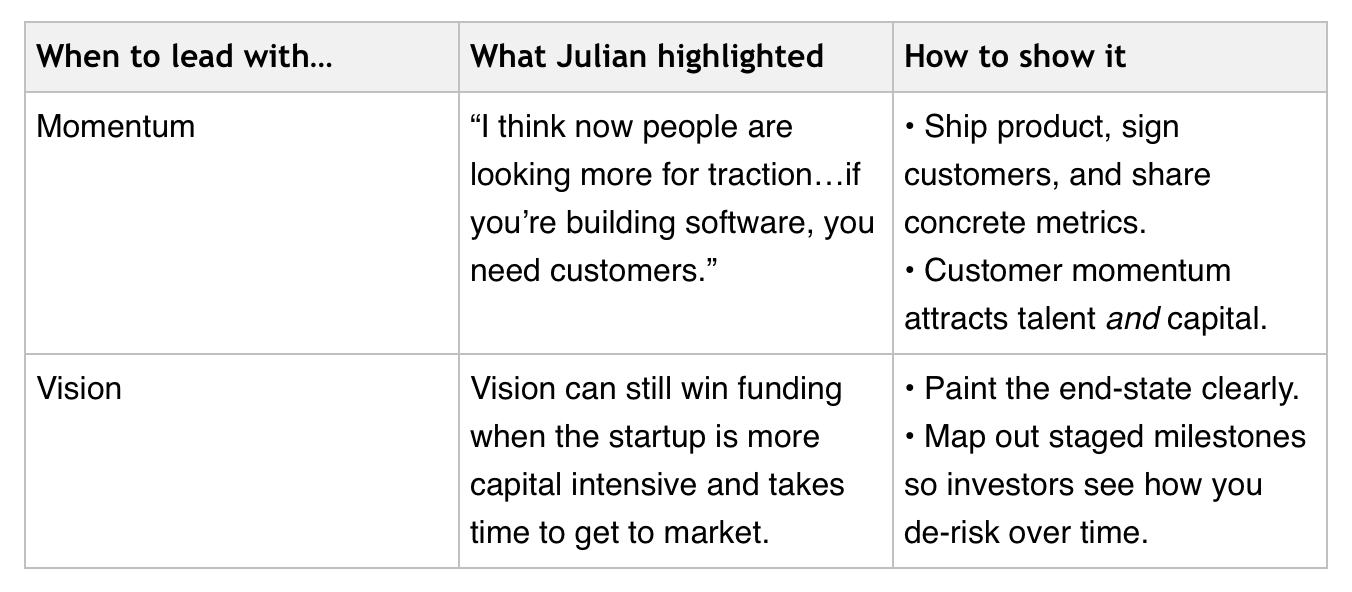
Remember: More product and customer momentum earns you better terms.
Thank you, Julian, for allowing me to share these insights with our solo founder community.
- Want the full session notes? Follow and DM @julianweisser.
- Building solo and evaluating term sheets? Julian is offering up his time to help you.
Like what you read? Pass it along to a friend and invite them to subscribe here.
— Julian, Kieran, and the SFP team