Elad Gil on the Co-Founder Fallacy

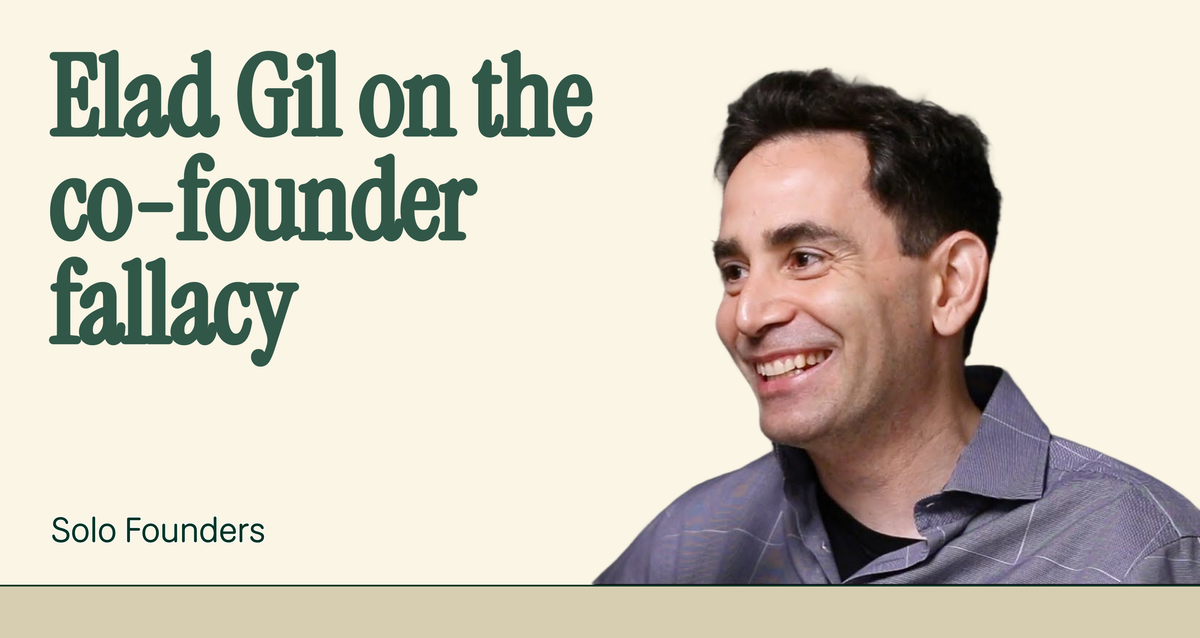
Elad Gil is one of the most respected investors in Silicon Valley — a solo GP with >$1B AUM and an investor in SpaceX, OpenAI, Stripe, and Anduril. In a recent fireside chat, he went after one of the most persistent myths in startups: that you always need a co-founder.
"There's a bunch of conventional wisdom in Silicon Valley that I think is always wrong, or mostly wrong. An example of that is: you always need a co-founder."
Elad’s argument is simple: look at the biggest market caps in the world and work backwards.
Michael Dell didn't have a co-founder.
Jeff Bezos didn't have a co-founder.
Larry Ellison didn't have a co-founder.
Bill Gates co-founded Microsoft with Paul Allen — but Allen left, and Gates became the sole driving force.
Steve Jobs had Steve Wozniak, but the dynamic was deeply unequal from the start. Jobs was the dominant founder.
"Over and over, it was either unequal or solo for many of the biggest things."
Elad's not arguing that co-founders are bad. Plenty of successful companies have had great co-founding teams, with Google being the most obvious example. Elad points out that even in those cases, the equity split often tells a different story: "If you actually look at cap tables as companies go public, you realize that most setups were unequal. It was really YC that normalized equality."
The takeaway shouldn’t be that solo is always better. The blanket insistence on co-founders is a recent invention driven more by accelerator batch-processing than by data.
The data backs him up
Elad's argument isn't a contrarian hot take. It's what the numbers show.
According to our own report using verified data from Carta, 36% of companies started in 2025 were solo-founded — up from 23% in 2019.
Meanwhile, the supposed risk of solo founding (the "hit by a bus" problem) seems irrational considering 25–30% of startups lose a co-founder before Series A anyway, often creating dead equity and messy cap tables that haunt companies for years.
What solo founders actually hear from investors
Elad’s observation about conventional wisdom resonates deeply with the experience of solo founders we’ve featured in our report and podcast.
Niels Hoven, solo founder of Mentava, said: “VCs were looking for a reason to say no, and angels were looking for a reason to say yes.”
Charles Hudson, founder and managing partner at Precursor Ventures, shared his view: “My preference is two deeply connected, tightly coupled co-founders. The second-best thing — and the third isn’t even close — is a really talented solo founder.”
When raising money, investors often give you reasons for not investing that aren’t honest. “You don’t have a co-founder” is a convenient excuse; the real reason is they just don’t believe yet.
The equity advantage nobody talks about
Perhaps the most practical implication of Elad's point is one he didn't dwell on, but that our founders live every day: when you start with 100% of the company instead of 50%, the math on everything changes.
Jimmy Douglas, founder of Plug, told us: "As a solo founder, I'm starting with at least 100% more equity than I would in a co-founder situation." That extra equity becomes a recruiting weapon. Jimmy met 55 people before making his first hire — and when he did, he could offer meaningfully more than the typical first-employee grant.
Flo Crivello made a similar point: "I can't imagine what it would be like if I had a co-founder and half as much equity. I certainly would have been a lot more stingy and would have fought harder to give up less ownership in every round."
Paul Klein IV, another solo founder, summed up the compounding advantage: "As a solo founder fundraising, I think you get more bullets. I raised a pre-seed that I probably didn't need and then raised a seed round four months later. Because I'm a solo founder, I have more equity."
The irony is clear: the thing investors sometimes penalize (starting solo) actually gives solo founders more flexibility to build better teams, take smarter risks, and be more generous with the people who matter most (including investors).
The conventional wisdom is shifting
Elad ended his point with a characteristically direct observation about what actually matters in startups:
"People often ask me what is the single biggest determinant of culture in a startup. And I say: winning. It's not the kombucha, it's not the ping-pong table. It's winning."
He's right. And what the data increasingly shows is that solo founders win at least as often as co-founded teams, and they keep more of the upside when they do.
The myth that you always need a co-founder served a purpose once. It simplified decision-making for accelerators and gave investors a pattern to match against. But the best investors like Elad are starting to say out loud what the data has been saying quietly for years:
You don't always need a co-founder. Sometimes you just need to start.
Elad Gil's fireside chat was hosted by South Park Commons. Quotes from solo founders are from the Solo Founders Podcast and report.