$9M ARR, Zero Investors: Yasser Elsaid on Bootstrapping Chatbase as a Solo Founder
Solo Founders Podcast — Episode 6 with Yasser Elsaid

Key Takeaways
- Yasser spotted the RAG opportunity before ChatGPT launched, built the first version of Chatbase in six weeks, and got his first Stripe payment 30 minutes after putting up a pricing page
- "Dictatorships are good when you're trying to build a company" — solo founders can move faster because there's no alignment tax on decisions
- The definition of success changes the moment you raise money. $100M ARR bootstrapped is an undeniable success. $100M ARR after raising $100M is just meeting expectations
- Individual sports (swimming, archery) taught Yasser the "everything is my fault" mindset that translates directly to solo founding
- Pricing is the fastest growth lever — there's no science, just experimentation. And margins don't matter early on because revenue signals are worth more than cost savings
Listen: YouTube | Spotify | Watch on X | Apple Podcasts
Introduction
Yasser Elsaid was in his last semester of university in Canada when he noticed something most people dismissed. Large language models were powerful, but they didn't have access to your data. This was before ChatGPT launched — Yasser was working with the DaVinci completion models, the predecessors to modern chat interfaces. He dropped out, built the first version of Chatbase in about six weeks, and got his first Stripe payment 30 minutes after putting up a pricing page.
Three years later: $9 million ARR, a 30-person team in Toronto, and zero outside investors. Chatbase has evolved from a "chat with your PDF" tool into an AI customer service platform that competes with companies that have raised orders of magnitude more capital. In this conversation with Julian, Yasser broke down the counterintuitive playbook that got him here — why he thinks like a dictator, why he hired too slowly, and why bootstrapping might actually give you higher chances of success than raising venture capital.
Seeing the Opportunity Before Anyone Else
Most founders talk about spotting a gap in the market. Yasser spotted a gap in the technology — and then bet that the technology would close it.
He was tinkering with side projects in his last university semester when he encountered what we now call RAG (retrieval-augmented generation). At the time, it didn't even have a name. People were writing papers about adding external data to language models, and a few hackers had built CLI tools. But no one had made it into a product.
"No market research, no talking to users, nothing like that. And I think that's the only way in a fast-moving industry like AI, because you don't have time to talk to users. There are no users. This is a new paradigm."
Yasser argues that in paradigm shifts, first principles thinking beats traditional market research. There's no one to interview about a product category that doesn't exist yet. You have to see what just became possible and build around it. Then you let the market push you toward what actually works.
He dropped everything — including his remaining classes — and built the first version of Chatbase in about six weeks. The urgency wasn't strategic. He simply believed that if the idea was good, someone else would build it first. That reasoning was wrong (good ideas don't have one-attempt windows), but the behavior it produced was right: extreme speed.
First Stripe Payment in 30 Minutes
The timing was everything. Yasser launched Chatbase and received his first payment through Stripe within 30 minutes of putting up a pricing page. That immediate revenue made bootstrapping viable from day one and eliminated the need to raise capital.
"I just saw the idea and I started building. I wasn't following the footsteps of 'first you need a pitch deck, then you talk to investors, then you find a co-founder.' I just saw the opportunity and started building."
Being in Toronto instead of San Francisco actually helped. Yasser wasn't embedded in the startup ecosystem, so he didn't follow the conventional playbook. No pitch decks, no investor meetings, no co-founder search. Just building and talking to customers. The revenue and customer volume came so fast that he never had time to do anything else — including sleep. He had angry customers calling at 2 AM while still technically enrolled in university.
The Benevolent Dictatorship
Julian asked Yasser about decision-making as a solo founder. His answer was blunt: dictatorships are good when you're trying to build a company.
His logic is simple. Either the founder is smart and the team trusts them — in which case, you want them to be a dictator, moving fast without wasting time convincing everyone. Or the founder isn't smart enough and the team doesn't trust them — in which case, the company fails regardless of its governance structure. The only path to outsized success runs through fast, opinionated decision-making.
"Dictatorships are good when you're trying to build a company."
This extends to how Yasser thinks about product evolution. The inputs change daily in AI. New models drop, competitors emerge, customer needs shift. Your job as a founder is to take in all available information, make the best decision you can from first principles, and then not have ego about reversing that decision when the inputs change.
He's built this into Chatbase's culture explicitly: changing your mind is celebrated, not punished. There's zero social pressure to stick with a decision because "we already put in the work." Sunk cost fallacy is treated as the enemy, not the norm.
Beyond Indie Hacking: Bootstrapping at Scale
Over dinner the night before the interview, Julian and Yasser coined the term "free solo" founding — bootstrapping as a solo founder with no co-founder and no investors, like free soloing in climbing. No safety net at all.
The indie hacker movement was always associated with lifestyle businesses and micro SaaS. Yasser is trying to prove that bootstrapping can produce generational companies. At $9 million ARR with a 30-person team, he's already outperforming most venture-backed companies at the same stage.
His financial philosophy evolved in stages. Early on: be conservative, make sure unit economics make sense, track profitability as the number one metric. Once you have conviction — once the steps to grow are clear and it's just about execution — flip the switch and spend aggressively. Yasser says Chatbase is now spending more than many VC-backed companies, funded entirely by years of accumulated profit.
"The definition of success changes as soon as you raise."
The argument against raising is threefold. First, you can build a brand strong enough that you don't need to borrow brand equity from a VC firm. Second, you maintain maximum optionality and control. Third — and most counterintuitive — bootstrapping might give you higher chances of success, because the bar for what counts as success doesn't get artificially inflated.
The B2B Playbook: Just Do the Boring Stuff
Toward the end of the conversation, Julian walked through several points from a playbook Yasser had published about bootstrapping an AI agent business. The advice was tactical and counterintuitive:
Content is non-negotiable. Organic content makes every other growth lever stronger — paid ads, outbound, word of mouth. It's not an alternative to sales. It's the foundation that makes sales work.
Attach a sales layer on top of self-serve. Bootstrap founders try to force B2B businesses to run like B2C apps because customer acquisition is cheaper. But at some point, bigger customers need to talk to a human. Chatbase added a sales team only 6-7 months ago, at around $7-8M ARR.
Be friends with your biggest customers. They become brand ambassadors. Word of mouth in one industry leads to dominance in that industry. This is the most undervalued growth lever, and Yasser wishes he'd started earlier.
Pricing is the fastest lever. There's no science behind pricing — the only way to find the right price is to experiment. Change it and immediately see market feedback. No other growth lever gives you that speed of signal.
"It's much easier to cut costs than to get more customers and revenue."
Margins don't matter early on. Revenue signals — a new customer, more brand awareness, more word of mouth — are worth more than the cost savings of running lean. Sacrifice $10 in margin for $10 in revenue, because the revenue compounds in ways that cost savings don't.
Bear Case, Bull Case
Yasser gave both sides with clarity.
The bear case: solo founding is hard, especially early on. Having a co-founder who is as invested as you makes life much easier — particularly during the chaotic period of finding product-market fit and getting the first customers. And some businesses simply don't lend themselves to solo founding. Research labs, deep technical hardware companies, businesses that require expertise you don't have — those need partners.
The bull case: it's very hard to lose as a solo founder. The number one startup killer is co-founder breakup. If you don't have that risk, you can always pivot, always adapt, always find a path forward. And a slightly below-average co-founder is much, much worse than being solo — you end up with arguments, gray areas of responsibility, and three-hour calls about small decisions.
Yasser's closing advice: if you don't know who your ideal co-founder is, try solo first. It's a two-way door decision. You can always bring someone in later.
"I like the fact that everything is my fault. And being solo gives me that satisfaction that everything is my fault."
About Yasser Elsaid
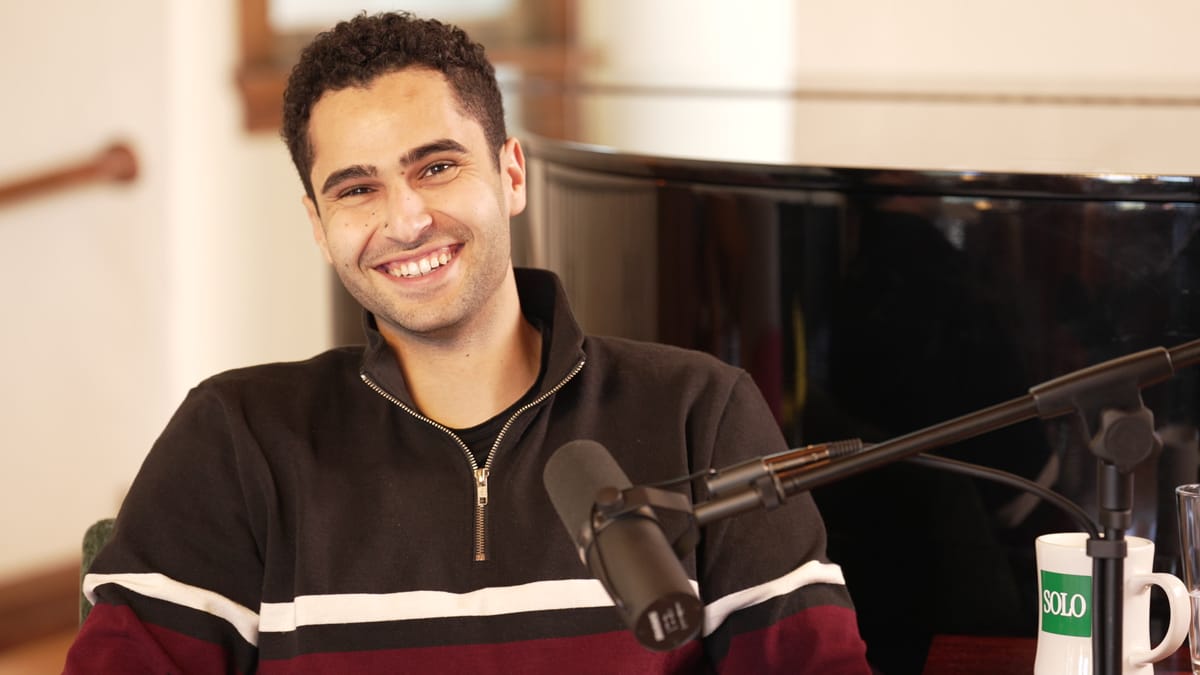
Yasser Elsaid is the solo founder and CEO of Chatbase, an AI-powered customer service platform that has grown to $9 million in annual recurring revenue — entirely bootstrapped with no outside funding. Originally from Egypt, Yasser moved to Canada for university and was building side projects when he spotted the opportunity to add custom data to large language models before ChatGPT even launched. He built the first version of Chatbase in about six weeks, got his first paying customer within 30 minutes of putting up a pricing page, and has since scaled to a 30-person team based in Toronto.
Subscribe to the Solo Founders Podcast on YouTube, Spotify, or Apple Podcasts.
Join our newsletter for weekly insights from solo founders.