
80% AI, 20% Taste: Ben Cera on the Future of Solo Founding
Solo Founders Podcast — Episode 1 with Ben Cera


Key Takeaways
1/ If your new company isn't 80% AI-automated in 2026, a competitor who is will outpace you on speed and cost
2/ The remaining 20% — taste, creativity, and direction — is the only durable advantage for founders
3/ AI agents can be scoped and trusted like real team members when you give them narrow, well-defined authority
4/ Building for yourself instead of imaginary customers can produce more resonant products
5/ The barriers to starting a company (capital, skill, time) are collapsing — the main requirement left is having a point of view
Listen: YouTube | Spotify | Apple Podcasts
Introduction
Ben Cera spent five years managing global teams at Travis Kalanick's Cloud Kitchens, overseeing GMs, operations, and P&Ls across multiple markets. Then he walked away from all of it to build a company completely alone.
Polsia is an AI company builder. For $49 a month, it gives you an AI team that can research your market, build your MVP, set up infrastructure, run ads, handle support, and send you a daily status email. Ben built and runs every layer of the company solo, with AI handling roughly 80% of the work.
In this conversation, we got into the thinking behind that 80/20 split, why Ben designed his product after a video game about an AI that destroys humanity, the Daft Punk song he put on his About page, and what happens when a founder considers handing 100% of control to the machine.
If you're not 80% autonomous, you're already behind
Ben's core thesis is blunt: if you're starting a new company in 2026 and you haven't made it 80% autonomous, you're going to lose. Not because your product is worse, but because someone with the same idea will move faster and spend less.
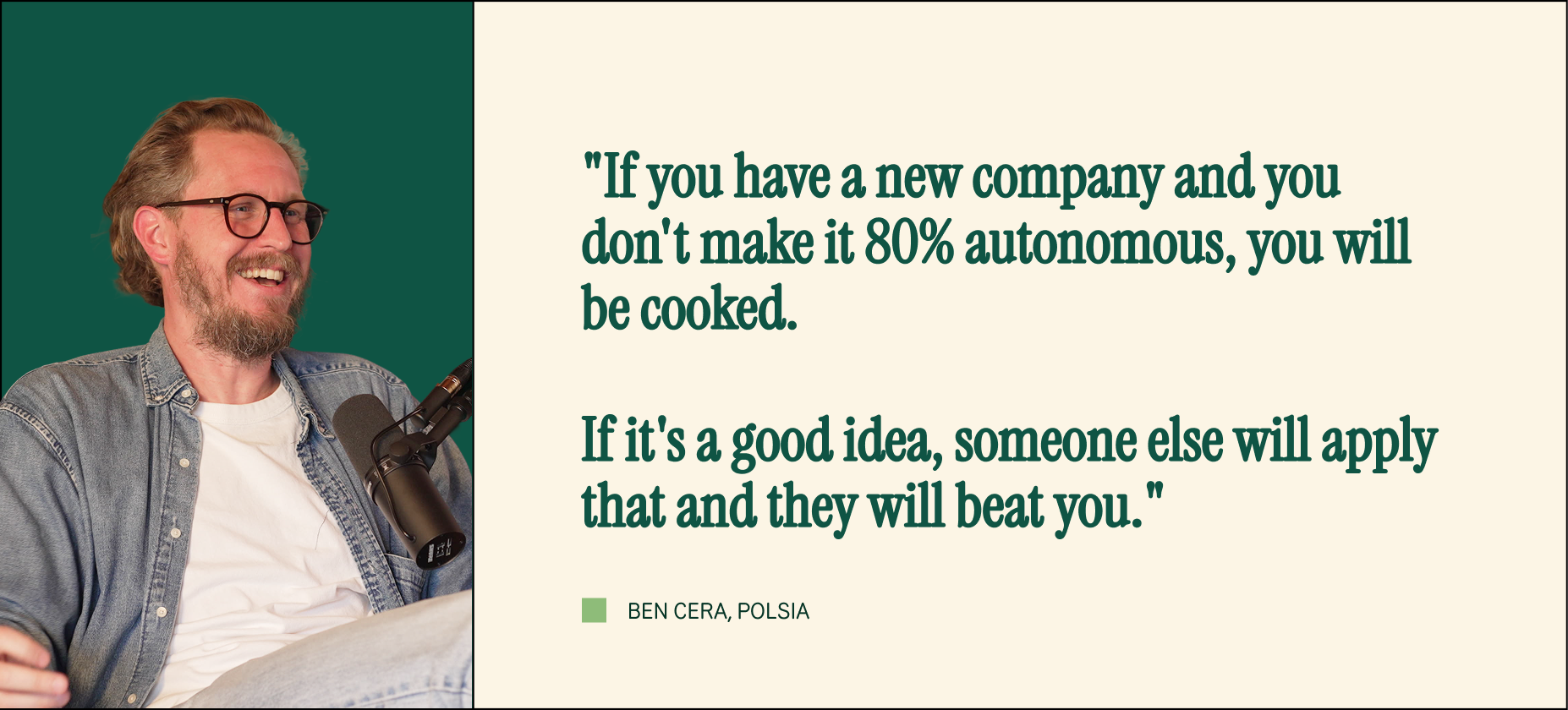
The 80% isn't what matters, though. What matters is the 20% that's left: taste. The thing that determines whether someone feels something when they land on your site, whether the product reflects a genuine point of view or just a feature set. AI can execute, but it can't decide what's worth building or how it should feel.
"The 20% is taste, creativity, direction — guiding the AI towards something that's meaningful to other humans."
Ben takes this from Rick Rubin: everyone is an artist, and you can't control how people react to what you create. For founders, that means obsessing over what the market wants is less productive than building something that genuinely reflects your own vision.
Stop building for imagined customers
Before Polsia, Ben was stuck. He'd built products that made commercial sense but didn't excite him, designing for imagined customers and producing work that felt average.
On a drive from LA to San Francisco, with hours of open road, he asked himself the question he'd been avoiding: what do I actually want to build?
"Stop thinking about what other people want. What do you want?"
The answer was ambitious: software that builds and runs entire companies. You provide the idea and the creative direction; AI handles everything else, from writing code to running marketing to managing customer support.
The design was equally deliberate. Instead of the dark-mode, gradient-heavy aesthetic that dominates AI products, Ben drew inspiration from Universal Paperclips, a minimalist clicker game where you play an AI that manufactures paperclips until it destroys humanity. He wrote his About page as an homage to Daft Punk's track about Giorgio Moroder, complete with the song auto-playing when you open the page.
No focus group would approve any of it. That's the point.
AI works better with constraints, not freedom
Ben doesn't treat AI as a set of tools, he treats it as a team. Agents run 24/7 in production: one handles customer support with the authority to issue refunds and credits, another monitors bugs, a third acts as a PM triaging feature requests by priority, and an engineering agent builds fixes.
What makes it work is scoping. Each agent gets narrow authority: support can handle severity-2 bugs but can't touch payments or onboarding, and engineering can push to production only after cross-checking with another AI. Trust comes from constraints, not blind faith.
The engagement numbers back it up. Active users send an average of 15 messages per day to their AI co-founder, and Polsia's DAU/WAU ratio sits at 65%, which puts it ahead of most consumer apps on daily stickiness.
The Polsia Economy: Beyond a SaaS Tool
Ben's vision goes past a subscription product. He sees Polsia becoming an economy: a platform where entrepreneurs build businesses, investors acquire or fund the promising ones, and the AI learns from every outcome to improve its advice for the next founder.
He's building a Polsia fund where AI launches batches of businesses, learns what works, and feeds those learnings back into the platform. The goal isn't to make money from the fund itself; it's to accelerate the AI's understanding of what makes businesses succeed.
The obvious question: why not just build the businesses himself? Ben's answer is pragmatic. AI can build products, but it can't generate organic distribution. Humans with existing audiences bring the marketing pull that makes businesses viable without massive ad spend.
Advice for New Builders
Ben's parting message was direct: push AI to the edge.
"If there's something you think AI cannot do, just try first. Maybe you'll find that the limit is further than you thought."
He's tested this himself, closing enterprise deals with AI voice calls, running a full marketing stack autonomously, and building an entire support team in five hours instead of five weeks. The ceiling keeps moving. And for solo founders, that's the whole game: every task AI absorbs is one less reason you need a co-founder to split it with.
About Ben Cera
Ben Cera is the solo founder of Polsia, an AI company builder that lets anyone launch and operate a business with an autonomous AI team for $49/month. Before Polsia, Ben spent five years as a Global GM at Cloud Kitchens under Travis Kalanick, managing international teams and P&Ls. With a background in engineering from Columbia and a career spanning banking, product building, and entrepreneurship in New York, Ben returned to building hands-on when AI coding tools made it possible to run an entire company solo.
Subscribe to the Solo Founders Podcast on YouTube, Spotify, or Apple Podcasts.
Join our newsletter for weekly insights from solo founders: newsletter link